Peri Jones is a Chartered UK and European Patent Attorney at Abel + Imray, where she works across physics, engineering, and technology patents. Alongside her IP career, she has built a strong interest in STEM outreach and science communication, helping make complex subjects feel more accessible and encouraging more young people, particularly girls, to consider careers […]
27th May 2026
Peri Jones is a Chartered UK and European Patent Attorney at Abel + Imray, where she works across physics, engineering, and technology patents. Alongside her IP career, she has built a strong interest in STEM outreach and science communication, helping make complex subjects feel more accessible and encouraging more young people, particularly girls, to consider careers in science.
Quick Profile
Name: Peri Jones Role: Chartered UK and European Patent Attorney Firm / Organisation:Abel + Imray Location: Cardiff, Wales Areas of expertise: Physics, engineering and technology patents, science communication, STEM outreach
Finding the right blend of science and communication
Peri’s route into intellectual property began with a long-standing interest in science. Growing up in North Wales, astronomy was always present at home thanks to her father’s passion for telescopes and astrophotography.
“My dad had, and still has, a big interest in astronomy and astrophotography,” she explains. “The house always had telescopes in spare corners.”
She went on to study physics at Cardiff University before completing a PhD in the astronomy instrumentation group. During that time, she also realised she enjoyed communication and writing just as much as the technical side of science.
At university, a talk from a trainee patent attorney changed her perception of what a STEM career could look like.
“I remember thinking this sounds like the perfect job,” she says. “I could combine technical expertise with communication, writing and working with inventors.”
What appealed most was the variety. Rather than focusing on one narrow technical field, she was drawn to the idea of working across a wide range of technologies and industries.
Now part of the Physics, Engineering and IT team at Abel + Imray, Peri works with clients across diverse sectors, from optics and lenses through to aircraft technologies.
Leaving academia behind
Although she enjoyed academic research, moving away from university life was not an easy decision.
“There was a little hesitation,” she admits. “Once you step away from academia, it can be difficult to go back.”
She enjoyed the research process and the collaborative environment of university life, but also recognised the uncertainty that often comes with academic funding.
“I didn’t want to spend my future constantly fighting for funding every couple of years and always worrying about what would happen next.”
The move into patent law gave her a chance to apply the skills developed during her PhD in a more commercially focused environment. Those transferable skills quickly became apparent.
“Writing a thesis helped with writing patent applications, reading research papers helped with reading prior art, and collaborating with different departments helped with dealing with inventors.”
She was also surprised by how quickly trainees become involved in client work.
“I naïvely thought I’d spend the first couple of years training in the background,” she says. “But from day one, you’re involved in real client work.”
The qualification process also brought its own challenges.
“I underestimated how difficult the exams would be,” she admits. “Failing an exam for the first time was a shock, but it definitely made me more resilient.”
Bringing science to wider audiences
Alongside her legal career, Peri has remained heavily involved in STEM outreach and science communication. That interest developed during university, where she became increasingly aware of the gender imbalance in physics.
“I started realising there was quite a big divide between males and females in physics when I was at university,” she says.
During her PhD, she began giving talks and media interviews, often in Welsh, to help make science feel more approachable and visible to wider audiences.
“I really get a kick out of trying to communicate difficult topics to the public,” she explains. “If you break things down properly, they don’t need to feel complicated.”
After completing her doctorate, she spent a year working with science communication company Science Made Simple, delivering talks and workshops in schools and at public events across Wales and beyond.
Peri was also the first Welsh-speaking science communicator employed by the organisation. This allowed them to deliver outreach activities through the medium of Welsh for the first time.
That experience left a lasting impression, particularly when visiting small rural schools across Wales.
“It was really rewarding going into these schools and showing children what they could potentially do,” she says. “A lot of the pupils came from similar backgrounds to mine.”
She believes representation and accessibility are both important when encouraging young people into STEM.
“We need to abolish STEM stereotypes and make science feel fun and accessible to everyone, particularly young girls.”
Communication at the heart of IP
Peri sees strong communication skills as central to both outreach work and intellectual property law.
Recently, she visited a Cardiff primary school where pupils were challenged to invent solutions to everyday problems.
“They came up with brilliant inventions,” she says. “Some were a bit far-fetched, but they were creative and they solved a problem, which was the brief.”
Experiences like these have reinforced the importance of explaining technical ideas clearly and confidently.
“When discussing complex topics, I always try to relate them to something day to day,” she explains. “I think about how I’d explain something to my family.”
That same approach carries through into her work with clients.
“I think being a patent attorney has made me a clearer science communicator,” she says. “You always have to think carefully about your audience.”
Balancing innovation with caution around AI
Like many within the profession, Peri sees artificial intelligence as one of the biggest developments currently shaping the IP landscape.
She believes AI has genuine potential to improve efficiency, particularly when reviewing or summarising prior art documents.
“I’m hoping AI can help make some parts of the process to be more efficient and cost effective,” she says.
However, she is cautious about relying too heavily on the technology.
“AI is a useful tool, but it needs to be used carefully because it isn’t always right.”
She believes the strategic and human elements of patent work remain difficult to replace.
“Writing a good patent application is about much more than describing an invention,” she explains. “You need to understand the client, their business goals and what they want from the patent.”
For Peri, relationships and trust remain central to the profession.
“Patent attorneys work closely with clients and build trust with them. I don’t think that human element can be replaced by AI.”
Life beyond IP
Outside work, Peri enjoys running, cycling and spending time in the mountains of North Wales.
One of her proudest achievements was completing an ultra-marathon along the Welsh coastal path from Penarth to Ogmore.
“It was tiring, but fantastic,” she says. “The weather behaved for once, which was a miracle.”
She is currently focused on returning to pre-baby fitness and hopes to complete the Swansea Half Ironman in the future after postponing the event during pregnancy.
Whenever possible, she still heads back to Snowdonia.
“If you get a clear day in the Welsh mountains, you can’t beat it,” she says. “I’m probably biased because it’s home, but they’re just fantastic.”
Looking ahead
Reflecting on her career so far, Peri believes resilience has been one of the most valuable lessons she has learned.
“Being a patent attorney has definitely made me more resilient,” she says. “It’s a challenging profession, but also a very rewarding one.”
She also hopes more young people will become aware of intellectual property careers earlier in life.
“I didn’t know anything about the IP profession until university,” she says. “That’s why outreach and visibility are so important.”
Contact Details
LinkedIn: Peri Jones LinkedIn Firm Website:Abel + Imray
Meet the IP Professional is a PatWorld interview series exploring the people and perspectives shaping the intellectual property profession. Discover more interviews in the Meet the IP Professional hub, and find out more about PatWorld — a global IP search provider working with IP professionals worldwide to support informed patent, design and trade mark decisions — on our About Us page.
Nathaniel Taylor has built his IP career around solving complex challenges in fast-moving sectors. These include electric vehicles, smart agriculture, and renewable energy systems. As a Director at Keltie and a Chartered and European Patent Attorney, he works closely with clients of all sizes. From high-growth startups to household names, he helps translate engineering ingenuity […]
3rd September 2025
Nathaniel Taylor has built his IP career around solving complex challenges in fast-moving sectors. These include electric vehicles, smart agriculture, and renewable energy systems. As a Director at Keltie and a Chartered and European Patent Attorney, he works closely with clients of all sizes. From high-growth startups to household names, he helps translate engineering ingenuity into strong, strategic IP portfolios.
We spoke to Nathaniel for our Meet the IP Professional series to explore the emerging tech he’s helping protect — and why good IP advice can be the catalyst for growth, agility, and long-term success.
From Engineering Student to IP Strategist
Nathaniel Taylor first encountered intellectual property during an engineering degree project focused on automating parcel-handling systems for Royal Mail. A visiting patent attorney explained how their solutions could be registered and licensed — a lightbulb moment that stuck.
“I realised I was really drawn to the conceptual and problem-solving aspects of engineering, rather than hands-on prototyping and manufacturing,” Nathaniel says. “A traditional engineering career would quickly become detached from any deep technical engagement, while IP offered a way to really stay connected to the core breakthrough technologies.”
That experience laid the foundations for a career focused on guiding innovative technologies through the patent process.
Driving Innovation in the Auto Sector
Nathaniel has worked on the electrification of vehicles at Jaguar Land Rover, which came at a key moment in the industry’s evolution. As the company developed new electric vehicle platforms, he was seconded to their team to harvest inventions and help draft a raft of patent applications directed to motor control systems for off-road performance.
“We were helping protect not just the tech, but the brand identity — preserving what makes JLR distinctive as they transitioned to electric platforms,” he explains.
His work for other automotive clients has included more speculative technologies, such as hydrogen propulsion systems. He helped clients draft patent applications with broad applicability, beyond hydrogen combustion applications, to retain utility even if the commercial interest in the hydrogen applications fell away. In emerging fields like climate tech, where innovation is fast-paced and outcomes are uncertain, he believes IP isn’t just about protection—it’s really about creating options and resilience.
Agri-Tech and the Power of a Strong Patent Portfolio
In the agricultural space, Nathaniel sees IP as a critical asset — particularly for startups navigating acquisition or scale-up. With automation and sensor-driven decision-making transforming farming, many smaller, tech-first firms are attracting interest from legacy players.
“Often, acquisitions are driven not just by talent and know-how, but by the underlying IP that provides a moat against competitive threats. A strong IP portfolio is what gives these companies leverage in negotiations,” Nathaniel says.
His focus is on helping these businesses secure practical protection while also positioning them for future funding and growth.
IP in the Age of Energy Flexibility
Renewable energy is one of the fastest-evolving sectors Nathaniel works in — and staying up to speed is essential. He regularly participates in innovation forums, founder communities, and sector events like London Climate Action Week to understand both technical developments and commercial realities.
One standout trend is the emergence of a diversified energy market that provides a greater variety of financing options for grid ancillary services. There are huge opportunities for companies to innovate and unlock new market opportunities, particularly with AI driving demand for electricity and data processing, Nathaniel expects a surge in IP activity in these areas over the coming years.
“These trends create whole new product categories. And that means opportunities for highly valuable IP.”
Supporting Startups with Practical IP Strategy
Nathaniel works closely with climate tech startups, many of which are navigating early-stage funding challenges and lack deep IP experience. At Keltie, he’s helped build support programmes tailored to these innovators. These include discounted initial services, educational resources, and pro bono partnerships with major law firms.
“We want founders to be empowered, not intimidated. IP isn’t just protection — it’s a growth tool.”
He also notes that the first patent application often serves as a key storytelling tool — something investors will review closely. That’s why clarity, technical accuracy, and commercial alignment all matter when drafting early filings.
Building IP That Can Pivot
Nathaniel believes flexibility is vital — especially for companies working with emerging or speculative technologies. He drafts patent applications with broader applicability, allowing clients to pivot to new sectors or adjacent markets without losing IP coverage.
“Your invention today might not be your business model tomorrow. We try to make sure the IP can evolve with you.”
That approach also helps with long-term licensing and commercial partnerships, where adaptable patent claims can open unexpected opportunities.
Filing with Global Vision
As both a Chartered and European Patent Attorney, Nathaniel brings a wide lens to global IP strategy. The European Patent Office has some of the strictest requirements — particularly around added matter — so he’s well-practised at drafting applications with foresight and jurisdiction-specific nuances.
“We’re always thinking ahead — how will this stand up in the US, UK, or Asia? And how might it need to evolve?”
He also highlights the UK’s 12-month fee-free period as an ideal first filing route for startups looking to make a low-cost but strategic move early on. Meanwhile, understanding key tools like the US grace period helps ensure clients are protected internationally.
What’s Next for IP in Emerging Tech?
Nathaniel sees several areas primed for rapid IP growth over the next 5–10 years:
Grid infrastructure and localised energy supply: IP filings in this space are expected to rise sharply as demand from AI and data centres grows.
Autonomous driving: With telecoms entering the automotive space, expect more IP disputes — but also more licensing and collaboration.
Data-driven agriculture: Large-scale sensor networks and precision farming will drive innovation — and require solid IP foundations.
Each of these trends reflects a broader shift: the convergence of traditional industries with new technologies and new players.
Life Outside the Office
When he’s not drafting claims or reviewing specs, Nathaniel enjoys golf, football, and a surprising new hobby: pottery, inspired by The Great Pottery Throwdown.
“I bought an electric spinning wheel online — slightly questionable wiring, but it’s working so far!”
He also recommends a walk along Bondi Beach in Sydney for stunning views, or a countryside ramble through King’s Langley farmland to the Cart and Horses pub — a personal favourite when visiting his family.
Final Thought: Build IP That Can Pivot With You
Nathaniel’s advice for startups and innovators? Successful IP strategy comes down to clarity, foresight, and agility. This is especially important in emerging sectors where commercial direction can shift rapidly.
“The most successful innovators are the ones prepared to pivot. We help ensure their IP can pivot with them.”
When Eric McGill talks about patents, you hear both the scientist’s precision and the strategist’s passion. A seasoned technology transfer expert who has worked with NASA, the FDA, and the U.S. Army, McGill has spent two decades helping inventors and institutions unlock the real-world potential of innovation. His latest venture—Patentelligence—is a bold response to one […]
6th August 2025
When Eric McGill talks about patents, you hear both the scientist’s precision and the strategist’s passion. A seasoned technology transfer expert who has worked with NASA, the FDA, and the U.S. Army, McGill has spent two decades helping inventors and institutions unlock the real-world potential of innovation. His latest venture—Patentelligence—is a bold response to one of IP’s most persistent questions: What is this patent worth, and what should I do with it?
From Lab Bench to Licensing Desk: A Personal Journey into IP
McGill’s path to technology transfer was far from typical. As a grad student working full time and newly married, he invented a product to solve a household issue—sparking his first interaction with the patent system. With help from a university contact, he filed for two patents and ultimately left school to commercialize the invention.
That experience launched a career rooted in both science and business. “It was never just about invention,” he says. “I became obsessed with the question: why do some ideas succeed while others fail?” That question continues to drive his work today.
Patentelligence: A Tool to Answer ‘Now What?’
Inventors and IP managers alike often struggle with what to do after securing a patent. That’s where Patentelligence comes in—an AI-powered patent valuation and decision-support platform that delivers fast, blind, and structured insight into a patent’s market value, commercial potential, and licensing viability.
The platform offers four report types—ranging from quick snapshots to comprehensive 360° briefings—each designed to be affordable, scalable, and tailored to different types of users, including inventors, startup founders, TTOs, and corporate IP teams.
“Our goal,” says McGill, “is to provide clarity at the exact moment people need to decide whether to pursue, pivot, or let go.”
Built with AI, Backed by Expertise
Unlike traditional patent valuation services that rely on time-consuming consulting or raw databases, Patentelligence leverages a blend of agentic AI, automation, and human oversight. It simulates machine learning processes to analyze public data and score a patent’s commercialization likelihood, market valuation band, and licensing income range.
“The system delivers client-ready insights in hours, not weeks,” McGill notes. “It’s not just faster—it’s consistent, repeatable, and grounded in real commercialization logic.”
Disruptive Pricing for an Underserved Market
One of the most transformative aspects of Patentelligence is its pricing. Where traditional reports might cost $5,000–$15,000, Patentelligence’s offerings start at just $97. Reports are usually delivered within one to two days.
“It’s not just about lowering costs,” McGill explains. “It’s about right-sizing insight. Most inventors don’t need a 30-page theory. They need to know: is this worth keeping? Can I license it? What’s a fair range?”
Solving a $6.4 Billion Blind Spot
One major target for Patentelligence is the widespread inefficiency in maintenance fee decision-making. Billions are spent each year to maintain patents—many of which will never generate returns.
McGill saw this problem firsthand early in his career. “At one lab, I was asked to make keep-or-drop decisions on patents—but there was no data to guide me,” he recalls. “It was just judgment.”
That experience inspired Patentelligence’s Maintenance Fee Intelligence Report, which gives data-backed go/no-go recommendations. It’s already proving valuable: university IP offices are beginning to adopt the tool to improve decision-making and reduce wasted spend.
Connecting Tools and Teaching
Patentelligence is one half of McGill’s larger mission. Through his educational platform, The Inventor’s Mentor, he helps inventors navigate the commercialization process and make better licensing decisions.
“Patentelligence is the toolkit,” he says. “The Inventor’s Mentor is the mindset training. Together, they offer inventors both the why and the how.”
Scaling Strategy, Not Just Technology
With a full launch coming soon under Patentelligence.AI, McGill hopes the platform will make IP intelligence more equitable and evidence-based.
“Too many great patents sit idle simply because decision-makers don’t know the next step,” he says. “We’re making that step clearer—and faster—for everyone.”
For McGill, it all comes back to a belief that’s guided him from the start: that smart, well-supported inventors can change the world. And with the right tools, they just might.
Fun Fact: Master of Molecules and Masala
When he’s not evaluating patents or building AI tools, Eric swaps algorithms for aromatics in the kitchen. He’s especially passionate about recreating Indian and Caribbean dishes—so much so that friends have joked he could give local restaurants a run for their money. Cooking, like innovation, feeds his deep curiosity and love of experimentation.
Connect with Eric
To learn more about Patentelligence or connect directly with Eric McGill, reach out via LinkedIn, or visit https://maintenance.enzumosstrategy.com/. His full suite of products will be launching August 2025. To speak to Eric about his work with early-stage inventors and those seeking patent licensing support go to https://www.theinventorsmentor.com/
Whether you’re a solo inventor, a university TTO, or a corporate IP leader, Eric is always open to conversations about smarter, faster paths to innovation.
P.S. Patent valuation is a powerful step in the innovation journey—and it’s even more effective when built on a solid foundation. PatWorld’s professional IP Search services can support innovators at the earliest stages, helping uncover prior art, assess novelty, and evaluate freedom to operate. It’s the ideal complement to the insights provided by Patentelligence. Explore how PatWorld can support your innovation journey: https://patworld.com/us/order-a-search/
If you ask Stephen Mohun how he got into intellectual property, he’ll be the first to admit it wasn’t a lifelong calling. “I’m ashamed to say it was nothing more than a job advert,” he confesses with a laugh. But sometimes the best careers start with curiosity—and in Steve’s case, it sparked a lifelong passion […]
30th July 2025
If you ask Stephen Mohun how he got into intellectual property, he’ll be the first to admit it wasn’t a lifelong calling. “I’m ashamed to say it was nothing more than a job advert,” he confesses with a laugh. But sometimes the best careers start with curiosity—and in Steve’s case, it sparked a lifelong passion for helping innovators protect and leverage their ideas.
Now the founder of Mohun Aldridge Sykes, Steve has spent nearly four decades advising clients on patents and trademarks, building a reputation for practical, strategic, and empathetic support—especially for those in the manufacturing and engineering sectors. His client base ranges from ambitious start-ups to global corporates, and his advice is always grounded in commercial reality.
“We always start with their bigger goals and work back from there. That’s how we build a real IP strategy—not just a filing plan.”
From Yorkshire Roots to Global Reach
Steve began his career at a local Yorkshire firm and worked his way through larger practices, eventually becoming a partner before founding the firm that became Mohun Aldridge Sykes. Launching his own boutique firm wasn’t just a career pivot—it was a chance to do things his way.
What sets Mohun Aldridge Sykes apart? It’s the depth of relationships. “We genuinely get to know our clients. We’re not just experts on the other end of the phone—we’re part of their strategic team.”
Intellectual Rigor, Commercial Focus
With a background in physics and a mind wired for problem-solving, it’s no surprise Steve is drawn to patent work. “I like understanding how things work,” he says. “Manufacturing clients, especially those in second or third-generation family businesses, are some of my favourites. They’re quietly innovating in ways they don’t always recognise.”
And that’s where Steve sees one of his biggest responsibilities: helping clients see the true value in their ideas. “Too many engineers dismiss their own work as ‘obvious.’ It’s our job to show them that what they’ve created might be valuable—and worthy of protection.”
Helping Clients Navigate Complexity
One of Steve’s great strengths is translating legal complexity into clear, actionable advice. “You have to put yourself in the client’s shoes. Legal jargon just puts up barriers. Our goal is to empower them.”
He’s particularly mindful of budget constraints for early-stage businesses. “The biggest mistake they make is spending too much too soon on the wrong things. We help them build a flexible, strategic IP plan that grows with them.”
A Trusted Partner in Innovation
Steve describes the ideal client relationship as one built on mutual trust. “They need to trust me to give honest, clear advice. And I need to trust that they’re telling me what’s really going on in the business.”
That trust has paid off—whether it’s guiding a manufacturing client into a leadership position through carefully managed IP, or helping a tech start-up secure patents in a notoriously difficult field. “That one surprised even me,” he says, recalling a breakthrough. “But we got there, and today those patents are their most valuable asset.”
Supporting the Next Generation
Mentorship matters to Steve. Mohun Aldridge Sykes welcomes interns and work experience students, giving them a real taste of the profession. “We’ve all had good careers in this field,” he says. “It’s important to put a bit back in.”
Staying Agile in a Changing Landscape
As AI and tech continue to reshape the IP world, Steve stays ahead by listening. “You’ve got to talk to people—clients, colleagues, other professionals—and keep your ear to the ground. The moment you stop adapting, you fall behind.”
His golden rule for entrepreneurs? Talk to your IP attorney early and often. “There’s no such thing as too early, but there’s definitely too late.”
Beyond the Office
When Steve isn’t advising clients or mentoring the next generation, you might find him on stage. A proud member of the Batley Gilbert and Sullivan Society, Steve regularly takes on leading roles—with his recent turn as the captain in H.M.S. Pinafore being a personal highlight. “Both my kids were on stage with me,” he smiles. “There’s nothing better than that.”
Get in Touch with Steve Mohun
With nearly four decades of experience in intellectual property, Stephen Mohun has built a reputation not just for legal precision, but for the kind of clear, trusted advice that clients remember. As founder of Mohun Aldridge Sykes, Steve blends technical expertise with commercial insight—helping innovators protect what matters and make confident decisions along the way.
How PatWorld Supports Firms Like Mohun Aldridge Sykes
At PatWorld, we understand that high-quality, professional patent searches are the foundation of strong IP advice. For firms like Mohun Aldridge Sykes—who focus on strategic guidance, commercial insight, and trusted relationships—our global patent search tools and analyst-led services offer an ideal complement. Whether it’s prior art, freedom-to-operate, or competitive intelligence, we help professionals like Steve deliver peace of mind to their clients with search services they can trust. Click for further information on PatWorld search services.
At the forefront of biotech patenting and innovation sits Ross Cummings, a partner at Gill Jennings & Every LLP (GJE), whose career has been shaped by scientific rigor, a deep commitment to clients, and a passion for future-forward technologies. With a PhD in molecular biology from the London School of Hygiene and Tropical Medicine and […]
23rd July 2025
At the forefront of biotech patenting and innovation sits Ross Cummings, a partner at Gill Jennings & Every LLP (GJE), whose career has been shaped by scientific rigor, a deep commitment to clients, and a passion for future-forward technologies. With a PhD in molecular biology from the London School of Hygiene and Tropical Medicine and nearly two decades of IP experience under his belt, Ross brings a rare fusion of technical depth and commercial strategy to one of the most fast-moving areas in intellectual property: cellular immunotherapy and RNA-based technologies. PatWorld sat down with Ross to discuss recent data relating to cellular immunotherapy, as well as his career journey, strategic insights, and the trends shaping the future of biotech IP.
From the Lab Bench to the Patent Bar
Ross’s journey into the world of patents began during his doctoral work on malaria enzymes. It was then that a Japanese patent, offering unexpected insights into his research, altered the trajectory of his thesis—and eventually his career. “It gave me the tools to push my research forward,” Ross reflects. “That was my first exposure to the value of patents—not just as legal instruments, but as sources of technical knowledge.”
Since then, Ross has become a trusted adviser to biotech innovators, working with companies across the UK, Europe, the US, and Asia. His experience spans everything from gene therapies and diagnostics to CRISPR and synthetic biology.
Navigating the Patent Boom in Cell and Gene Therapies
Ross’s enthusiasm for biotech is palpable, particularly when discussing the renaissance in RNA and cell therapies. “We’re in a period of rapid acceleration,” he says. “COVID-19 changed everything. It proved RNA technologies could be safe, fast, and effective, and that opened the floodgates.”
The data backs this up. Landscape charts generated by PatWorld show a sharp rise in first-priority patent filings over the past decade in cellular immunotherapy—a trend Ross believes is sustainable, provided financing remains strong. “We feel very busy, and that’s usually a good indicator,” he notes.
Figure 1: First Priority Year (see Landscape Charts)
Global Trends and Shifting Hubs
When reviewing Figure 2, which maps first-priority countries, Ross notes the dominant presence of the US in this space. “That’s not surprising—the US biotech scene has much deeper funding,” he comments. “But the UK is punching above its weight, even if some of that activity is driven by a handful of companies.”
He also points to China’s rapidly growing interest in antibodies and biologics. “We’re seeing more biotech filings from China, and companies there are now licensing innovations back to US pharma firms. That’s a shift worth watching.”
Figure 2: 1st Priority Country (see Landscape Charts)
Strategic IP in a Crowded Landscape
For biotech start-ups working in competitive areas like RNA or CAR-T therapies, Ross stresses the importance of early, robust data. “The patent system is shifting—strong experimental support is more important than ever,” he explains.
He also encourages companies to embrace flexibility: “A narrow claim might still be powerful in biotech, especially if it directly protects your approved product. It’s about tailoring your IP strategy to your development path.”
The Human Element in High-Stakes Innovation
Ross is especially motivated by the potential of these therapies to transform lives—particularly for children with rare diseases. “For the first time in history, many of these genetic conditions have real hope,” he says, adding that early screening and fast action can make all the difference.
He also sees platform technologies and adaptable delivery mechanisms as crucial to expanding access to these innovations, both scientifically and commercially.
Looking Ahead: Synthetic Biology and Sustainability
Beyond therapeutics, Ross is enthusiastic about the future of synthetic biology. “We’re approaching a time where we can manufacture materials and chemicals using engineered organisms rather than fossil fuels,” he says. “That has massive implications—not just for IP, but for the planet.”
Inside GJE: Collaboration, Clarity, and Client Focus
Ross describes Gill Jennings & Every as a firm where collaboration and adaptability are central to the culture. “It’s not a siloed environment—we build cross-disciplinary teams to match our clients’ evolving technologies,” he explains. That flexibility is especially valuable in a sector where biotech increasingly intersects with AI, diagnostics, and chemistry.
This approach has helped GJE earn double gold recognition in the IAM Patent 1000 rankings. Ross attributes that success to the firm’s emphasis on clarity, commercial awareness, and strong client relationships. “We focus on practical advice, not just legal precision. We aim to become a real extension of our clients’ teams.”
Beyond the Office
When he’s not helping clients navigate patent law, Ross enjoys life with his young family, reading a mix of sci-fi and science history, and keeping fit. He’s also an advocate of internal knowledge sharing at GJE, from legal updates to seminars on new biotech tools—ensuring both the law and the science stay front of mind.
P.S.PatWorld supports IP professionals like Ross by providing tailored reports that make navigating complex patent landscapes more efficient and informed. Whether it’s freedom-to-operate (FTO) searches, invalidity assessments, or in-depth landscape reports, PatWorld delivers actionable insights across a wide range of technologies. From global trend analysis to highly focused data sets, our support helps attorneys stay ahead of the curve.
The data visualisations referenced in this article were created by Geraint James, Senior IP Manager at PatWorld, using the Questel platform.
From diagnostics to cannabis-based therapeutics, Sophie Topham’s career in biotech patent law has been anything but predictable. A Senior Associate in the biotechnology team at Marks & Clerk, Sophie’s calm, analytical approach is matched by a refreshing curiosity—qualities that have made her an invaluable asset to clients and colleagues alike. We caught up with her […]
9th July 2025
From diagnostics to cannabis-based therapeutics, Sophie Topham’s career in biotech patent law has been anything but predictable. A Senior Associate in the biotechnology team at Marks & Clerk, Sophie’s calm, analytical approach is matched by a refreshing curiosity—qualities that have made her an invaluable asset to clients and colleagues alike. We caught up with her to hear about her work, career path, and the rare case that led to one of her most widely read articles.
From Immunology to Innovation
Sophie’s current docket spans a broad range of biotechnology innovations. While she regularly works with immunology-based diagnostics and oncology-related inventions (including peptide vaccines and tools for identifying oncogenic mutations), her work is as diverse as the biotech field itself.
“Over the last few years, I’ve also worked in the cannabis field, particularly with extracts and synthetic cannabinoids for medical uses,” she explains. “And more recently, I’ve seen an increase in devices—some that resemble ELISAs on a chip, others that use antibodies in more novel ways.”
Despite the increasing overlap between biotech and AI, Sophie admits she still has a soft spot for what she calls “pure biology.” “As a biologist by training, those are the ones I find the most intuitive to work with.”
A Curious Case of Prior Art
In 2024, Sophie penned an article about an unusual and educational experience: having a client’s own clinical trial proposal cited as prior art against their European patent. It was the first time she’d encountered such a scenario—and it proved just as useful for the IP community as it did for her personally.
“Opponents in an EPO opposition cited the client’s trial proposal, which we hadn’t seen before due to a team change on the client’s side,” she recalls. “I had to dig into the case law to understand how such documents are interpreted, especially regarding whether the invention was truly disclosed.”
The case raised interesting questions around whether and how other documents—such as scientific publications—can be used to interpret clinical trial proposals, and how that squares with the EPO’s guidelines.
Understanding the Unusual
Sophie is quick to point out that having clinical trial proposals cited as prior art is still uncommon. “Patent applications in biotech typically don’t require clinical data to be granted. In vitro data is often sufficient for meeting plausibility requirements, so most companies file before trials begin,” she says.
Still, her experience highlighted how easy it is for assumptions to trip up even the most diligent teams. “We’ve seen clients express genuine surprise that their own publications can be cited against them—especially in Europe where there’s no grace period.”
The Route Not Taken
Like many in the IP profession, Sophie’s path wasn’t a straight line. “I originally wanted to be an airline pilot,” she laughs. “But when airlines stopped sponsoring training, the cost became unrealistic. Then I remembered a careers talk we had at university about being a patent attorney. I looked into it, and here I am.”
With a background in biological natural sciences from Cambridge, Sophie’s analytical mindset found a perfect home in IP law. She’s since seen applications through from drafting to grant, oppositions, and even appeals.
“Seeing something I’ve written be granted—and knowing I helped a startup gain recognition through their patent—those are the highlights,” she says.
Life Outside the Office
When she’s not deep in a patent claim, Sophie is rarely still. “I always try to move—walk, cycle, yoga, strength training. Even when working from home, I’ll build exercise into my day.” She’s part of a cycling club and makes time for a proper lunch break most days—usually with some kind of movement.
Evenings are more relaxed: cooking from scratch, reading anything from spy novels to translated Japanese fiction, and planning her next getaway. This summer, she’ll finally fulfil a childhood dream—horse riding along the beaches of Morocco with her twin sister.
If Only There Were More Hours…
When asked which fictional invention she’d most like to patent, Sophie doesn’t hesitate: “Hermione Granger’s Time-Turner. I’d love more hours in the day. If I knew how it worked, I’d make one!”
With her blend of sharp legal insight and grounded, genuine enthusiasm for the science behind the patents, Sophie brings a distinct human touch to biotech IP. Whether she’s tackling tricky prior art or galloping down a Moroccan beach, she’s doing it with purpose and passion.
Marks & Clerk is a leading international firm of intellectual property experts, providing comprehensive patent, trade mark, design, and litigation services. With a global presence and deep sector knowledge, Marks & Clerk supports innovative companies from startups to multinationals in protecting and leveraging their IP assets.
How PatWorld Supports Biotech Innovators
At PatWorld, we help biotech companies, attorneys, and researchers access fast, reliable, and intuitive global patent search tools. Our advanced search and analytics features enable professionals like Sophie to:
Senior Managing Attorney, Pure Ideas From Engineering to SME Success From defense to design, gas turbines to gadgets, Vikki Townsend’s three-decade journey through the world of intellectual property (IP) is as dynamic and multidimensional as the technologies she helps protect. Currently Senior Managing Attorney at Pure Ideas, Vikki leads a team of patent and trademark […]
25th June 2025
Senior Managing Attorney, Pure Ideas
From Engineering to SME Success
From defense to design, gas turbines to gadgets, Vikki Townsend’s three-decade journey through the world of intellectual property (IP) is as dynamic and multidimensional as the technologies she helps protect. Currently Senior Managing Attorney at Pure Ideas, Vikki leads a team of patent and trademark attorneys with a focus on helping SMEs not only secure their innovations but also understand how to maximize their commercial value.
Falling into IP — and Finding a Calling
“I sort of fell into IP by happy accident,” Vikki recalls. With dual master’s degrees in engineering and biomedical engineering, she was on a path toward medical technology when job opportunities in the field proved elusive. A patent officer role at the Ministry of Defense opened the door to a whole new world. “I didn’t know what to expect,” she says, “but I found I really enjoyed it.”
Her early experiences included interrogating the inner workings of everyday objects in job interviews and working with inventions that reminded her of her grandfather’s love of quirky gadgets. It quickly became clear: this wasn’t just a job, it was a perfect fit.
From Jet Engines to Software to SatNav
Over the years, Vikki has worked across engineering, aerospace, medical devices, and software. One standout experience involved reverse-engineering gas turbine engines to better understand geared architectures. Another was working on early patents for satellite navigation systems, before satnav became a staple in every smartphone.
What links these disparate sectors? “You see things go from concept to something really cool and everywhere,” she says. “You never stop learning.”
A Practical IP Partner for SMEs
At Pure Ideas, Vikki’s passion lies in helping small and medium-sized businesses use IP as a strategic tool, not just a legal checkbox.
“Many SMEs come to us thinking ‘I need to protect this,’ but often they don’t realize the bigger picture,” she explains. Vikki and her team begin by understanding a client’s commercial goals: Will the product be made in-house? Will they need collaborators? What are the real risks and opportunities?
“We give them a wider understanding, not just of registered rights like patents and trademarks, but also how to safeguard trade secrets, negotiate access to third-party IP, and avoid unintentional infringement.”
IP in Action: Webinars, Podcasts, and Warzones
A natural communicator, Vikki has become an influential voice in IP education. Through webinars and podcasts, she tackles real-world challenges SMEs face, from drafting effective IP agreements to navigating collaborative innovation.
One compelling initiative is her work with Remote Area Risk International, a network helping to solve medical challenges in remote and high-risk areas. With her defense and medtech background, Vikki offers guidance on protecting innovations in extreme environments.
“It’s amazing what people can come up with using limited resources. That ingenuity deserves protection,” she says.
Championing Inclusion and Innovation
Vikki is also a vocal advocate for diversity and inclusion in the IP world, having worked with Rolls-Royce’s Inclusion Council and IP Inclusive. Her passion project? Supporting the IP sector’s menopause initiative — a topic she believes is long overdue for open discussion.
“I’ve always felt a bit of a square peg,” she admits. “But I’ve found communities where difference is celebrated. That’s where I belong.”
Life Beyond Law: Boxing, Theater, and the Big Screen
To decompress from the pressures of senior IP practice, Vikki turns to karate, boxing, and the performing arts. She volunteers at a local performing arts academy and even made a cameo as a barmaid in a short horror film that went on to win awards at the Brighton Rocks International Film Festival.
“It was a happy accident,” she laughs, echoing the phrase that started her IP journey.
Advice for Aspiring IP Professionals
To young professionals, especially women, Vikki says: “Go for it. Believe in yourself. You’ll face challenges, but this is a rewarding career that never gets boring.”
She adds, “You don’t need to come from an elite university. Curiosity, creativity, and communication are just as valuable.”
Why This Matters to SMEs
Vikki’s story embodies the ethos behind PatWorld’s mission: connecting innovators with the tools, insights, and people they need to succeed. SMEs often underestimate the value of their ideas or overestimate what IP registration alone can achieve. Through expert insights from professionals like Vikki, and by providing access to comprehensive IP searches, PatWorld helps demystify intellectual property and supports innovation from idea to industry.
To get in contact with Vikki visit Pure Ideas or connect with her on LinkedIn.
PatWorld IP Search Services
PatWorld supports patent attorneys like Vikki with professional, reliable IP search services that underpin smart, strategic decision-making. Whether you’re preparing to file, evaluating prior art, or advising clients on freedom to operate, our search solutions are built to support your success.
In the dynamic world of intellectual property (IP), protecting innovation requires a tailored approach that resonates with clients’ unique needs. PatWorld sat down with Vicki Strachan, UK and European patent attorney and founder of Strachan IP, to explore her career journey, the evolving IP landscape, and how she helps innovators safeguard their ideas with a […]
10th June 2025
In the dynamic world of intellectual property (IP), protecting innovation requires a tailored approach that resonates with clients’ unique needs. PatWorld sat down with Vicki Strachan, UK and European patent attorney and founder of Strachan IP, to explore her career journey, the evolving IP landscape, and how she helps innovators safeguard their ideas with a personalized, client-centric strategy.
From Engineering to IP Expertise
Vicki Strachan’s career began with a degree in electrical and electronic engineering, but she quickly realized hands-on engineering wasn’t her calling. “I wanted to use my degree differently,” she says. In 1992, she joined the UK Patent Office as an examiner, leveraging her technical background to assess patent applications with precision. This role honed her ability to dissect complex inventions, a skill she now uses to provide insightful advice to clients. However, the civil service’s lack of drive for excellence didn’t suit her ambition.
This led her to train as a patent attorney in Cardiff, followed by roles in London and a year in Jersey. Over the years, she gained extensive experience across various firms, including managing an office in Oxford. Her time as a patent examiner gave her a deep understanding of patentability criteria, which she applies to craft robust patent applications and guide clients through the intricacies of the IP system. While these roles offered valuable insights, Vicki saw opportunities to better support smaller clients, who could sometimes find traditional firm structures challenging, particularly when faced with complex language or unexpected costs. The 2020 lockdown reinforced the idea that a more flexible, client-centered approach was possible without the need for a physical office. This realization led her to establish Strachan IP, where she focuses on delivering bespoke services tailored to each client’s business and personality. “It’s about adapting to who they are and how they work,” she explains.
Addressing Common IP Challenges
Vicki identifies two key challenges in the IP space: a lack of awareness and negative perceptions. “Some innovators don’t know what IP is,” she notes, “while others think it’s costly or ineffective.” Drawing on her examiner experience, she helps clients understand patent requirements and avoid common pitfalls, ensuring their applications are both strategic and cost-effective. She prioritizes education through plain-English blogs, answering common questions, and securing speaking engagements to reach business owners and founders. “We need to show what IP can do for them,” she says, debunking myths like the idea that big companies ignore IP rights.
Her approach emphasizes clear communication, avoiding jargon to make complex IP concepts accessible, helping clients understand how IP can protect their products and add value to their businesses.
Navigating a Global IP Landscape
In an increasingly globalized market, ensuring IP compliance across jurisdictions is critical. Vicki drafts patent specifications with both US and European patent systems in mind, leveraging her examiner experience to anticipate the scrutiny applications will face. “Most Western jurisdictions align with either the US or European model,” she says. “By considering both from the outset, we cover most bases.” This strategic approach helps clients protect their innovations internationally, whether they operate locally or explore global licensing opportunities.
The Impact of AI and Technology
The rise of AI is transforming the IP landscape, raising complex questions about ownership. “Who owns AI-generated innovations or creative works?” Vicki asks. “In Europe, it’s leaning toward the person who set the AI’s conditions, but there’s no clear answer yet.” The rapid pace of technological advancement, far outstripping legislative updates, creates a gap in IP law. “Technology moves so fast,” she says, “from brick-sized mobile phones to smartphones in decades. IP laws struggle to keep up.” Vicki stays informed by tracking case law, guiding clients through these uncertainties with insights gained from her examiner background.
She also highlights the relevance of trade secrets in today’s software-driven world, drawing parallels to famous recipes like KFC or Coca-Cola. “Registered IP isn’t for everyone,” she notes, “but we encourage clients to consider what adds value to their business.”
Booming Sectors for IP
Vicki points to three sectors where IP is increasingly vital: AI and machine learning, autonomous vehicles, and green technology. “AI innovation is booming,” she says, “but autonomous vehicles and electric cars, especially range improvements, remain hot patenting areas.” Green tech continues to drive innovation as sustainability takes center stage, with companies competing to secure first-mover advantage through robust IP strategies.
A Tailored Approach to IP Strategy
Strachan IP’s hallmark is its bespoke service. Vicki shares two examples: for early-stage startups referred by product development companies, she engages throughout the development process, using her examiner expertise to identify patentable elements and potential infringement risks before filing. For larger founder-led tech businesses, she conducts regular IP portfolio reviews, ensuring clients maintain only relevant IP tied to active products. “This prevents spending on obsolete patents while protecting their core business,” she explains. Her approach considers the client’s business stage, cash flow, and communication preferences. “Every client is unique,” Vicki says. “We tailor our service to their needs and personality.”
Evolving Client Expectations
Over her 30-year career, Vicki has seen a shift in how clients approach IP. “When I started, the legal field was transactional and self-important,” she recalls. “Lawyers dictated terms without much explanation.” Today, clients, especially younger ones, demand clarity and involvement. “They want complex issues explained so they can apply them to their business,” she says. Her examiner background enables her to break down technical and legal complexities clearly, aligning with this demand for transparency and fostering client involvement in decision-making to align strategies with their goals.
The Future of IP
Vicki envisions a future where the IP industry continues to prioritize education. “It’s about helping clients use the IP system to their advantage,” she says. By empowering businesses to strategically leverage IP, she sees a path for innovators of all sizes to drive growth and protect their creations.
Leadership and Client Relationships
Vicki’s leadership and client relationship style is adaptable and empathetic. “I’m good at reading what clients or employees need and adjusting my approach,” she says. Leading by example, she tailors communication to suit individual personalities, fostering trust and clarity. This skill, refined over decades, underpins Strachan IP’s client-centric model.
Rewarding Moments at Strachan IP
For Vicki, every day at Strachan IP is rewarding. “Running my own business and delivering work I love in a way clients appreciate is a privilege,” she says. Mentoring her employee through exams, earning merits and distinctions, is a highlight. “Helping someone grow their career is fulfilling,” she adds, “as is the loyalty of clients who’ve stayed with me over the years.”
Advice for Aspiring IP Professionals
To aspiring IP lawyers, particularly women, Vicki advises staying true to personal values. “Working against your values is stressful and unrewarding,” she says. Despite entering the profession when women faced skepticism, she encourages aligning work with personal principles for a fulfilling career. “Times have changed,” she notes, “but authenticity is key.”
Beyond the Office: Vicki’s Passions
Outside work, Vicki is a creative and curious soul. She enjoys watercolor painting and fine pencil drawing, though she needs the right headspace to dive in. A medieval history enthusiast, she also practices skipping—not just jumping rope, but mastering complex steps in her garden with her three dogs as her audience. “It’s tougher than it looks,” she laughs.
Vicki’s Recommendation
A true crime enthusiast, Vicki recommends Emma Kenny’s YouTube channel. “She analyzes cases from a psychological perspective, exploring what makes people tick,” Vicki says. Based in Manchester, Emma’s engaging storytelling is a must-watch for those fascinated by human behavior.
About Strachan IP
Vicki Strachan is a UK and European patent attorney and founder of Strachan IP, a firm dedicated to providing tailored IP solutions for innovators, from solo entrepreneurs to growing tech businesses. Learn more at www.strachanip.com. Connect with Vicki on LinkedIn: Vicki Strachan.
PatWorld IP Search Services
PatWorld supports patent attorneys like Vicki with professional, reliable IP search services that underpin smart, strategic decision-making. Whether you’re preparing to file, evaluating prior art, or advising clients on freedom to operate, our search solutions are built to support your success.
Freedom to Operate Searches: Why Quality, Experience, and Communication Are Essential For patent attorneys, the importance of a thorough and reliable Freedom to Operate (FTO) search is well understood. As a crucial step in assessing potential patent infringement risks before product launch or market entry, the quality of the FTO search has direct implications for […]
6th May 2025
Freedom to Operate Searches: Why Quality, Experience, and Communication Are Essential
For patent attorneys, the importance of a thorough and reliable Freedom to Operate (FTO) search is well understood. As a crucial step in assessing potential patent infringement risks before product launch or market entry, the quality of the FTO search has direct implications for strategic decision-making and risk management.
With many search providers available, it’s important to choose a partner who not only understands the technical and legal dimensions of FTO work but also aligns with your standards of responsiveness and quality.
At PatWorld, our goal is to support attorneys with detailed, jurisdiction-specific analyses that help inform sound legal opinions and provide confidence in complex commercial environments. This post outlines what sets our FTO search services apart—and why attorneys across the globe continue to trust PatWorld with their most critical IP assessments, time and again.
What Defines a High-Quality FTO Search?
An effective FTO search is characterised by its relevance, clarity, and depth. It should:
Identify potentially relevant third-party rights with precision.
Focus on enforceable patents within jurisdictions of interest.
Be tailored to the specific product or process in question.
Deliver findings in a format that facilitates legal interpretation and advice.
At PatWorld, we combine claim analysis with technical experience to ensure that each search reflects the practical needs of attorneys and their clients. We take the time to understand the commercial context and align our approach accordingly.
Why the Right Search Provider Matters
Selecting the right FTO search partner can significantly affect the reliability and usability of the results. At PatWorld, we prioritise:
Clear and proactive communication: We work closely with clients to define scope and expectations. Pre-search consultations with the search team, and regular progress updates are readily available to ensure alignment throughout the project.
Extensive experience: Our team has over 200 years of combined IP search experience, across a wide range of subject matters.
Efficient turnaround: We understand time pressures and deliver searches promptly, without compromising quality.
Competitive pricing: We offer clear, fixed-rate quotes wherever possible, ensuring confidence in cost and avoiding last-minute surprises.
These qualities contribute to long-term client relationships built on trust and consistent delivery.
Reducing Risk Through Reliable Support
Our reports are structured to be both comprehensive and easy to interpret, allowing attorneys to quickly assess key issues and determine next steps. We are also available to provide clarification and support throughout the process.
A Professional Relationship You Can Rely On
At PatWorld, we value the professional relationships we have built with our clients. For some, we have conducted hundreds of FTO searches, providing consistent support across multiple projects, sectors, and jurisdictions. We understand that trust is earned through experience, reliability, and results.
We take pride in being a responsive and dependable extension of your team. Whether it’s adjusting to evolving requirements, meeting urgent deadlines, or collaborating across time zones, we adapt to your needs. Our commitment to ongoing partnership ensures a seamless and effective working relationship, built on mutual respect and shared standards of excellence.
Conclusion: Trusted by IP Professionals Worldwide
The value of a dependable FTO search provider cannot be overstated. At PatWorld, we combine experience, communication, and efficiency to support attorneys in delivering the highest quality advice to their clients.
We take pride in the trust we’ve earned from attorneys and IP professionals worldwide. If you’re seeking a partner who brings not only expertise, but consistency and responsiveness, we’d be pleased to support your next FTO search.
World IP Day 2025 – “IP and music: Feel the beat of IP” Feel the Beat of Innovation: Exploring Music Tech IP with Iain Russell of Russell IP. Music is more than rhythm and melody — it’s deeply entwined with invention. From the earliest mechanical instruments to today’s AI-generated soundscapes, the intersection of music and technology is constantly evolving. […]
25th April 2025
World IP Day 2025 – “IP and music: Feel the beat of IP”
Feel the Beat of Innovation: Exploring Music Tech IP with Iain Russell of Russell IP. Music is more than rhythm and melody — it’s deeply entwined with invention. From the earliest mechanical instruments to today’s AI-generated soundscapes, the intersection of music and technology is constantly evolving. And at the core of this innovation is intellectual property (IP), quietly shaping the soundtrack of our future.
This World IP Day, PatWorld sat down with Iain Russell, UK and European patent attorney and founder of Russell IP, to talk about music technology, the role of patents in creative innovation, and what it means to truly “feel the beat” of IP.
Passion Meets Profession
Iain Russell isn’t just a seasoned patent attorney — he’s also a lifelong musician and founder of DefibFest, a music-driven not-for-profit supporting public access to defibrillators. “Music’s always been there,” he says. “It’s my passion, alongside patents.”
This dual perspective gives Iain a unique lens on innovation. He combines legal expertise with hands-on musical insight, making him particularly attuned to the needs of UK-based music-tech innovators.
A Patent Perspective on Music Tech
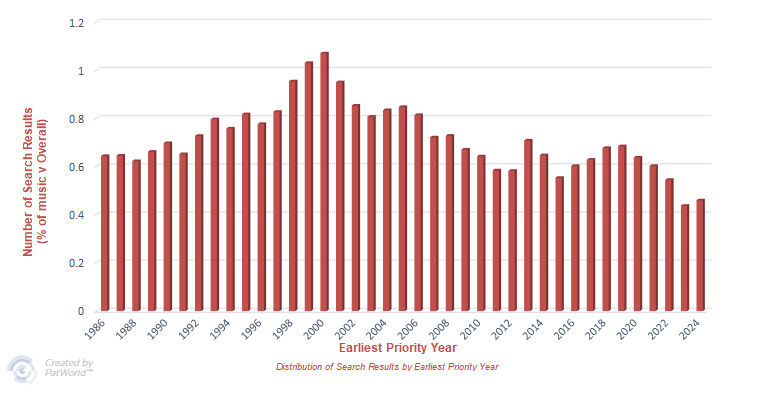
Filing Trends (Music v All %)
The team at PatWorld recently analysed global patent activity in the music technology space. The findings — covering trends over the past 40 years — revealed intriguing patterns. While overall filing volumes have increased significantly, music-related filings have maintained a steady, if relatively niche, share of global innovation, accounting for around 1% of all filings.
“That might sound small,” Iain says, “but when you consider the sheer number of sectors covered by patents — from pharmaceuticals to telecoms — it’s actually quite remarkable that music tech consistently holds its ground. It’s alive and kicking.”
Though fluctuations exist, the data indicates a resilient and relevant sector. “The technology behind music is evolving rapidly,” Iain adds. “A lot of innovation has continued around musical instruments and hardware, and there is increasing growth in areas like software (for example, DAW plugins), and now generative AI.”
Surprising Innovators — and Why They Matter
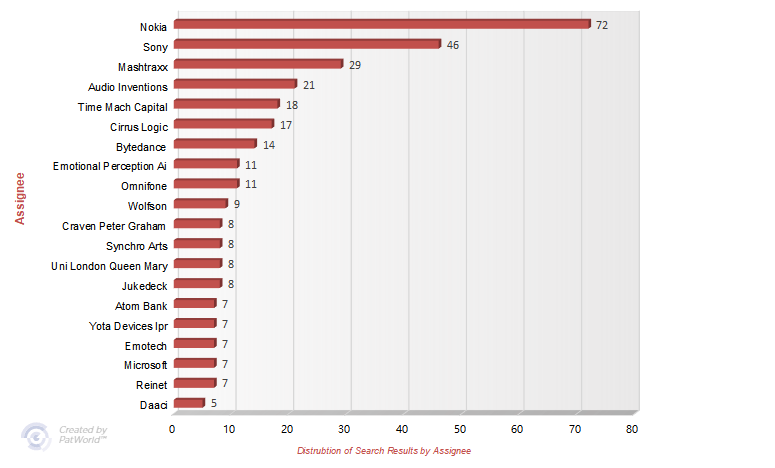
One of the more unexpected findings in the PatWorld data was the presence of non-traditional music companies among the top UK-based patent filers in music tech — names not typically associated with instruments or music.
Assignees
According to Iain, this may reflect how music overlaps with audio, voice recognition, UX design, and even AI platforms. “You start with questions like ‘what is music tech?’ and you realise it blurs into other sectors. Some of these filings may be classified under music, even if music isn’t the core focus.”
These cross-sector innovations highlight the value of due diligence. “For start-ups especially, resources are limited. But understanding who’s working in your space — even tangentially — can help shape a smarter IP strategy,” says Iain.
Prosecution Realities: Music vs. Finance
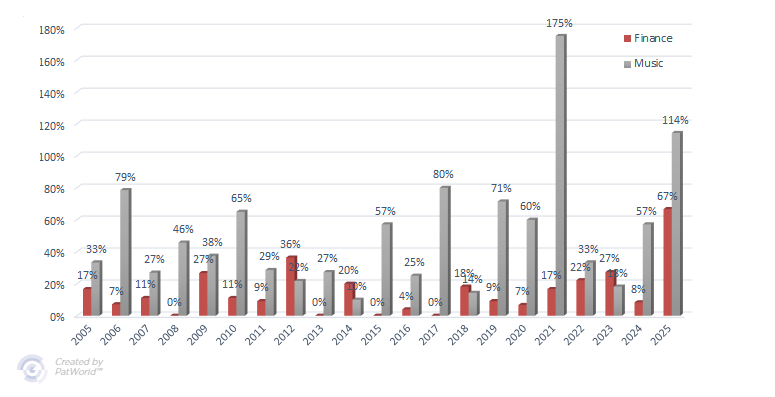
Another striking insight from the data was the comparison between software patent outcomes in music versus finance. In the UK, music-related software patents have consistently higher grant rates than financial software.
Prosecution Outcomes
Why? “Music tech often involves real-world signals — audio captured by microphones, processed, and output in new ways,” Iain explains. “That tends to be seen as more ‘technical’ under UK patent law. Financial software, which some patent offices consider to be about processing more abstract data, faces a steeper challenge.”
The takeaway? Music tech is a relatively fertile ground for software-based patents as well as patents with a hardware focus — a critical insight for inventors unsure about what is patentable.
The Global Soundstage
Patent filing activity in music tech is geographically diverse, with strong representation from China, the US, Japan, Europe, and South Korea. For UK-based companies, this raises important strategic questions.
Territories
“Even if you’re just operating locally, you need to think internationally,” Iain advises. “You might not plan to sell in the US or Japan, but someone else might — and licensing or selling your IP could be a revenue stream. The key is to consider your options early.”
Emerging Themes: AI, MIDI and More
Iain is particularly interested in the evolving world of AI-generated music, but his fascination stretches back to what might be seen as the humble MIDI file — a digital representation of the ‘DNA’ of certain types of music.
“Technology lets us record, edit and produce music in ways that were unimaginable when I first started recording music in my parents’ garage 25 years ago,” he says. “With a basic setup, I can now create a full track — vocals, guitar, drums, effects — from my home. It’s endlessly creative, and patents play a part in enabling that creativity.”
As AI continues to redefine what’s possible in music, the lines between creator, instrument, and software can grow increasingly blurred — a challenge for innovators, and an opportunity for those who understand the IP landscape.
Advice for Music-Tech Innovators
For early-stage music-tech companies, Iain offers a few guiding principles:
– Know your IP toolkit: patents, trade secrets, trademarks, registered designs, and especially copyright can all play important roles in music-related ventures.
– Do your research: novelty searches, competitive analysis, and understanding prior art can significantly increase your chances of success.
– Find the right support: working with advisors who understand both tech and music helps make your case clearer to examiners and collaborators.
Above all, Iain encourages innovators not to underestimate what’s patentable: “Even in something as well-established as guitars, there are thousands of patents — pickups, strings, fretboards, you name it.”
Celebrating Music and IP — Together
World IP Day is a reminder that behind every beat, riff, and chorus, there’s innovation at work. It’s in the algorithms, the amps, the apps, the streaming platforms, and the instruments themselves.
And thanks to professionals like Iain Russell, the inventors driving this innovation have someone to help them protect it.
About Russell IP
Iain Russell is a UK and European patent attorney and founder of Russell IP, a firm dedicated to supporting tech innovators. He’s also an inventor and lifelong musician.
DefibFest is a not-for-profit event raising money for life-saving defibrillators through the power of live music. Watch this space for more on their October 2025 event in London.
Postscript: Supporting the Beat Behind the Scenes
At PatWorld, we work closely with patent attorneys and IP professionals to provide the reports and insights they need to support innovators — including those operating in the ever-evolving music technology space. We use intuitive patent search databases, combined with expert-led support and training, helps uncover competitive landscapes, track filing trends, and strengthen client strategies.
To find out how PatWorld can support your firm or in-house team, check out the links below or contact us directly on [email protected].
Patent, Design, and Trademark Research Experts with a combined experience of over 200 years in Intellectual Property searching. Highly trained, dynamic in-house research teams specialising in a wide range of subject matter. All our analysts follow a training program developed by former IPO Examiners. Our teams are available to discuss any specific technical points regarding your search enquiries.














 Order a Search Now