When it comes to securing exclusivity in the life sciences sector, few bring the depth of insight and strategic clarity that Francis Tierney offers. A qualified UK and European patent attorney since the 1990s, Francis blends decades of in-house experience with a boutique advisory approach that gives life sciences companies a genuine edge—particularly in pharmaceuticals and small molecule therapeutics. In this article PatWorld discusses with Francis Exclusivity in Pharma, and Navigating the Life Sciences Patent Landscape.
From In-House to Boutique: A Unique Perspective
Francis began his IP career in-house, spending nearly three decades advising on agrochemical and pharmaceutical innovations before moving into private practice. This “poacher turned gamekeeper” transition, as he jokingly puts it, equips him with an intuitive understanding of how clients operate and what they truly need from their IP counsel.
Now at Patent Boutique, he works closely with clients on prosecution, opposition, appeal work, due diligence, and strategic portfolio development. His tailored, hands-on approach is a hallmark of the firm.
The Five Pillars of Patent Strategy in Pharma
Francis sees five key IP considerations for life sciences companies today:
Confidentiality: With increased pressure to publish and attract investors, ensuring non-disclosure before filing is vital.
Timing of Filings: Filing too early can lead to protection ending earlier during peak sales; too late, and companies risk being scooped.
Collaboration with R&D: Patent attorneys need to work closely with research teams to react quickly to emerging data and shape strategy in real time.
Market Awareness: Limited budgets mean companies must prioritise filings in jurisdictions most critical to commercial success.
AI: Keeping abreast of developments in, and the increasing capabilities of, AI.
Getting Patent Drafting Right
Drafting for small molecules brings its own hazards. “If you draft too broadly, not only might your claims be rejected, but you risk creating your own most damaging prior art,” Francis warns. He emphasises the importance of including strong biological data—especially for markets like China—and ensuring that patents will remain enforceable 20+ years down the line, particularly when linked to SPCs.
US vs. Europe: Avoiding a Common Pitfall
One of the most frequent issues Francis sees is US-based companies underestimating global disclosure rules. “There’s a grace period in the US, but not in Europe. Smaller companies often publish during the priority year, which can be problematic for later filings,” he explains.
He also notes how different legal frameworks—such as the EPO’s problem-solution approach versus the US’s obviousness standard—can yield very different outcomes from the same prior art.
Early-Stage Advice: Flexible, Focused, and Fast
Emerging biotech companies often need more tailored support, especially when balancing speed, disclosure, and credibility for investors. Francis helps them navigate this by streamlining prosecution strategies and ensuring they have grantable, meaningful patents to support licensing or M&A activities.
“Established pharma companies have structured IP processes. Start-ups don’t—so we help them build systems and strategies that are credible and cost-effective,” he says.
Patent Portfolios as Deal Enablers
Whether supporting collaborations or preparing for acquisition, Francis views robust IP portfolios as central. “You need to show what you’ve got, but also what you might be developing. Priority filings before a deal are key to demonstrating value,” he advises.
AI in Drug Discovery: A New Frontier, with Caveats
Francis acknowledges AI as a potential game-changer in small molecule R&D, but with caution. “If AI knows everything, where’s the inventive step?” he asks. He sees a possible future where narrower, more focused patent claims become the norm due to more precise AI targeting—but also where validity could well be questioned if algorithms become standardised tools.
A Call for Change: Grace Period Reform
If he could change one thing in the UK or EU IP landscape, Francis would introduce a broader grace period. “It would protect researchers from the kind of accidental disclosures that can destroy patentability. A safety net—not to rely on, but to support honest mistakes.”
The Boutique Advantage
At Patent Boutique, Francis and his colleagues offer flexibility, cost transparency, and a collaborative approach. “We were cloud-based from the start, so our clients benefit from seamless document transfer, real-time communication, and scalable support,” he notes. Clients also gain access to a wider network of trusted attorneys—competency, not size or shine, is what counts.
Outside the Office: Gardening and Grandkids
Beyond the world of SPCs and claim drafting, Francis is a proud grandfather and a keen (and increasingly enthusiastic) gardener. “It’s such a contrast to patent law—where you wait years for a result. In the garden, you plant something and within weeks, there’s colour, texture, and reward,” he says. His latest pride? A set of stunning Alstroemeria —particularly a variety called Indian Summer.
Connect with Francis Tierney 🔗 Francis Tierney on LinkedIn 🔗 Patent Boutique – A specialist firm offering high-level, strategic patent services tailored to life sciences and beyond.
P.S. How PatWorld Supports Patent Attorneys Like Francis PatWorld supports IP professionals with expert-led Patent, Trademark, and Design Search services. Whether you’re advising clients on exclusivity strategies, preparing for prosecution or opposition, or managing complex portfolios, our tailored search solutions deliver the clarity and confidence you need to move forward.
When you think of a patent attorney, you might picture someone firmly rooted in legal texts. But for Lewis Mullholland, the path into IP began thousands of miles from home—embedded in an R&D team at Cisco Systems in Shanghai, tackling early cloud computing challenges.
“It was a fascinating time,” Lewis recalls. “We were pushing the boundaries of what cloud computing could do. That’s where I first encountered IP—not in theory, but as a practical force shaping innovation.” What began as a hurdle—navigating standards full of patented technologies—became an inspiration. “I saw patents not as obstacles but as drivers of invention. You had to think creatively around them, and that mindset stayed with me.”
Today, Lewis is a Chartered and European Patent Attorney at WP Thompson, with a practice spanning mechanical, electrical, and software technologies. He’s also a registered representative before the Unitary Patent Court, making him one of the legal professionals shaping Europe’s evolving IP landscape.
Serendipity and Strategy
Lewis’s route into the profession wasn’t entirely planned. “After returning from China, I had a potential opportunity to train as a patent attorney in Japan. But a conversation with my grandad led to a different route—a chance meeting with a Liverpool-based firm that ultimately launched my career.”
That was over a decade ago, and Lewis has stayed with WP Thompson ever since. “It just felt right,” he says.
His engineering background remains central to how he works. “Engineers solve problems. Patent law, especially at the EPO, is also about solving problems—framing arguments with clarity. I always try to describe an invention as though I’m talking to my nan. If she can understand it, it’s probably a good specification.”
Listening to Clients, Staying on the Front Line
Lewis’s approach to staying current isn’t just about journals or legal updates. “I like to visit clients, talk to their R&D teams, see what’s happening on the ground. That’s often where you get the best insights—seeing what innovations are bubbling up before they hit the headlines.”
This on-the-ground approach also helps tailor strategies for clients of all sizes. “For startups, it’s about making every penny count. Tools like the UKIPO’s IP Audit scheme can be game changers. For multinationals, it’s about managing large portfolios and aligning strategy with business goals.”
On AI, Ownership, and the Wild West
AI is an unavoidable topic in IP law—and Lewis doesn’t shy away from its challenges. “It’s a quagmire,” he admits, pointing to thorny issues like authorship of AI-generated works and ownership rights over training data. “The UK needs a more robust framework. The tech’s evolving fast, and the UK’s principles-based approach to AI regulation has to keep pace.”
Lewis is pragmatic about AI’s place in his own profession. “AI won’t replace patent attorneys—but it can enhance us. We are incorporating AI into our practice, enhancing and streamlining its normal operation. However, there’s a big caveat: it only works well in the hands of someone who knows what they’re doing. You need expertise to ask the right questions and spot the hallucinations.”
High Stakes, Higher Standards
Lewis also has an insider’s view of the UPC, Europe’s new patent enforcement regime. “It’s faster and cheaper—but also higher risk. If a core piece of IP is critical to your business, you need to tread carefully. Many clients are cautiously sticking with the national systems, at least for now.”
His attention to detail has paid off in difficult cases. He recounts one where the client’s own journal publication was blocking a grant. “It came down to a date in the metadata. I challenged the examiner’s assumption and found the proof. That was the turning point. Once we removed that document from consideration, all the related objections fell away.” The lesson? “Never assume the examiner is right—go back to first principles.”
Beyond the Desk
Outside the office, Lewis has a few unexpected pursuits. He’s currently tackling the Couch to 5K programme and recently walked 35 miles of the Wirral Way. “It’s not quite a marathon yet,” he laughs, “but I’m enjoying the journey.” He’s also revisiting classic Stephen King novels. “I read ‘Thinner’ recently—his early stuff has a certain edge to it.”
These interests, Lewis says, help him connect with clients. “It’s about more than just law. Clients are people. If you can relate to them, they’re more likely to trust you with their ideas.”
Looking Ahead
As for the future of IP law? “All eyes are on AI. It’ll reshape how we examine, register, and enforce IP. But we need to stay human in how we use those tools. There will always be a place for patent attorneys—so long as we evolve with the technology.”
PatWorld supports patent attorneys like Lewis Mullholland with professional, reliable IP search services that underpin smart, strategic decision-making. Whether you’re preparing to file, evaluating prior art, or advising clients on freedom to operate, our search solutions are built to support your success.
From ground-breaking materials research to CrossFit competitions, and from optoelectronics to intellectual property (IP) law, Dr Elliott Davies has carved a multifaceted career that bridges science, law, and leadership. In this edition of Meet the IP Professional, we sit down with Elliott Davies, Patent Attorney, to discuss the journey from physics to patents, the evolving IP landscape, and the values that drive his work with clients across the UK and beyond.
A Journey from the Lab to Legal Practice
After earning a Master’s and a PhD in Physics from the University of Bath, Elliott made the leap from academia into the world of IP—a profession he admits was largely unknown to him at the time.
“There wasn’t a clear path from academia to IP law back then,” Elliott explains. “I had a vague idea I liked law, but I also wanted to hold onto the scientific knowledge I’d built up. Becoming a patent attorney offered the best of both worlds.”
A Methodical Mindset—and an Eye for Detail
It was Elliott’s methodical approach during his final year university project—developing soft magnetic materials for submarine stealth applications—that earned him the British Aerospace Prize for outstanding research. That same precision now serves him well in his legal work.
“In patent law, language is critical. Something as small as a misplaced comma can completely alter the scope of protection,” he says. “Learning to write clearly and concisely has been one of the most valuable skills I brought with me.”
From Football Coaching to IP Mentorship
Elliott’s leadership skills aren’t just forged in the office. As a local football coach for young children, he’s learned the value of patience, clarity, and breaking complex ideas into manageable steps—skills he applies when mentoring trainees in the IP profession.
“It’s about getting the basics right before progressing,” he says. “Whether it’s coaching or onboarding a new attorney, small steps and steady support make all the difference.”
Facing Fears and Growing Through Challenges
Though he jokes about a fear of heights, Elliott identifies public speaking and workplace conflict resolution as his true professional challenges. “We’re trained in law, not necessarily in managing people or speaking in front of large audiences,” he reflects. “But you learn. You keep working at it.”
Innovation, Protection—and the Rise of AI
With over 20 years of experience, Elliott has seen the IP landscape evolve significantly. While legal frameworks often lag behind emerging technologies, he points to artificial intelligence as the most pressing frontier.
“People are using AI to generate patent applications or seek legal advice, but the quality can be superficial. It’s shiny on the surface but lacks depth,” he warns. “AI won’t replace attorneys, but it will transform how we work. We need to be ready.”
Supporting Start-ups and SMEs from Day One
Through his work with the Welsh Government and academic institutions, Elliott has championed early IP engagement for SMEs and start-ups.
“Too often, people wait too long to think about IP. Whether it’s a patent, trademark, or design, these protections should be in place before you go public, certainly with patents” he says. “And good contracts are just as important as registrations.”
Design Rights: The Unsung Hero
Design rights, often overlooked in favour of patents or trademarks, are another area where Elliott sees hidden value.
“They can be quick and cost-effective to secure—but get them wrong, and they’re hard to enforce,” he says, citing the well-known Trunki suitcase case. “It’s not about just filing a form. It’s about doing it right.”
A Portfolio Approach to Innovation
Elliott’s work with clients like Alesi Surgical—known for their Ultravision™ medical technology—highlights the importance of ongoing innovation.
“You start with a core idea, but to stay protected, you need a ring-fence of patents that cover improvements and developments over time. That’s how you build a long-term competitive edge.”
Education and Outreach
Passionate about raising awareness of IP, Elliott regularly teaches at Cardiff University’s School of Dentistry, delivering a module on IP Law as part of their qualification. In addition, Elliott gives presentations to early-stage innovators.
“IP was under the radar when I was a student. I want to change that. Helping people understand and protect their ideas is incredibly rewarding.”
Staying Ahead in a Fast-Moving World
With expertise spanning semiconductors, photonics, telecoms, and medical tech, staying up to date is no small feat.
“It’s tough,” Elliott admits. “I lean on newsletters, industry briefings, and—frankly—my clients. They’re at the forefront, and we’re riding that wave with them.”
Mentorship and Team Culture
As Head of Legal Practice and Compliance Director at Wynne-Jones IP, Elliott plays a central role in shaping both client services and internal culture.
“At Wynne-Jones, we’re not a huge firm. Everyone plays a vital role. That gives us agility and a genuine team ethos. We try to make sure everyone understands how the whole business works.”
He’s especially passionate about mentorship. “When I started, I had a brilliant mentor. I try to offer that same calm, patient guidance to those entering the field today—especially with so many working remotely. It can be difficult to learn soft skills from behind a screen alone.”
Life Outside the Office
When he’s not working on patents or compliance, Elliott pushes his limits with Hyrox events—a mix of endurance running and fitness challenges.
“It’s a bit like a hangover. You always say ‘never again’, but then you sign up for the next one,” he laughs.
And his favourite childhood memory? “Family trips to Blackpool or simple days out at the beach or zoo. It wasn’t about the destination—it was about doing it all together.”
Final Thoughts
Elliott Davies embodies the blend of technical precision, legal expertise, and human connection that defines today’s leading IP professionals. Whether mentoring the next generation, protecting cutting-edge tech, or navigating the fast-evolving world of AI, his work continues to shape the future of innovation.
P.S. At PatWorld, we’re proud to support patent attorneys like Elliott and firms like Wynne-Jones through our expert IP search services. Whether you’re looking for prior art, freedom to operate, or patentability searches, our team delivers high-quality, reliable results to help you make confident decisions. Explore our search options here: https://patworld.com/us/order-a-search/.
Patent litigation and opposition proceedings often come down to one thing: prior art. A successful legal strategy requires a robust body of evidence that can challenge the novelty or inventive step of a granted patent. PatWorld partners with patent attorneys to deliver strategic invalidity analysis that supports stronger legal outcomes.
With a combined experience of over 200 years supporting IP professionals, our expert team delivers high-quality reports and results you can trust. We leverage a broad range of databases, resources, and proprietary methodologies to provide insight-driven solutions that meet the highest standards.
The technical scope of patents is broad — so is our expertise. PatWorld employs a team of highly trained professionals covering all major areas of science and engineering, including life sciences, software, electronics, mechanical devices, and green technologies.
When you need to move fast, we move with you. Our confidential, responsive service ensures you receive comprehensive support at every stage of your legal process.
Why Work with PatWorld?
Expertise across all scientific and engineering domains
Reports formatted to support legal proceedings
Non-obvious prior art sources explored thoroughly
Fast, confidential service trusted by UK and EU attorneys
In today’s hyper-competitive and complex global marketplace, Freedom to Operate searches for multinationals are no longer a luxury — they are a necessity. For multinational corporations navigating diverse legal frameworks, launching a product without a detailed understanding of the surrounding patent landscape can lead to costly delays, litigation, or even a forced market exit.
PatWorld supports in-house legal, innovation, and R&D teams with jurisdiction-specific analysis that pinpoints potential IP risks before they become roadblocks. Our professional team, experienced in patent searching across all technology fields, delivers results for that are accurate, timely, and easy to act upon.
Speed and precision matter at scale. That’s why our search services integrate advanced patent tools with deep sectoral expertise. Whether your organisation is moving into a new jurisdiction or developing a breakthrough product, our reports are built to slot seamlessly into your internal decision-making process.
Our multidisciplinary team includes professionals with backgrounds in pharmaceuticals, engineering, IT, materials science, and more. This diversity enables us to understand the innovations you’re developing and deliver high-quality results in any technical domain.
Why Choose PatWorld?
Trusted by leading multinational in-house legal teams
Skilled in every major area of technology
Reports tailored for strategic decision-making
Access to a global network of patent data
Responsive, confidential and collaborative support
From ballroom dancing and ten-pin bowling to guiding cutting-edge startups through the complexities of intellectual property, Andrew Flaxman has certainly had a diverse journey. Today, as a partner at Bristol-based IP firm Stevens Hewlett & Perkins (SH&P), Andrew is a passionate advocate for startups and a specialist in software, computing, and AI-related patents.
The Path to Patents
Andrew didn’t set out to become a patent attorney. In fact, it wasn’t until the final week of university that he picked up a leaflet that introduced him to the profession. With a love of physics, a knack for language, and a curiosity about the law, the role seemed like the perfect fit. He began his career in London before making the move to Bristol, eventually rising to partner level, and joining SH&P earlier this year.
A Day in the Life (Is Never the Same)
“There’s no typical day,” Andrew says. “I might be dealing with emails, drafting patents, speaking to clients, attending partner meetings, or at a conference. Every day brings something new.”
That dynamic workday is part of what makes the job so compelling—especially for someone who thrives on innovation and the unknown.
Championing Startups
Andrew’s enthusiasm shines when it comes to supporting early-stage ventures. He works closely with the SetSquared Bristol community and is especially proud of SH&P’s initiative Pitch and Protect, which awarded £10,000 in IP support to a start-up to help them get their first patent on file.
“Startups are looking for advisors who genuinely want to help,” he says. “We’re flexible and hands-on—being part of a firm that can adapt quickly is a real advantage.”
Debunking IP Myths
One of the most common misconceptions Andrew encounters? “Startups often think there’s no point in filing patents because they can’t afford to enforce them,” he explains. “But having IP can deter infringement and is a valuable business asset. It’s normally better to have rights than to have none at all.”
He also frequently hears from clients in computing and software who wrongly believe their ideas can’t be patented. “It’s a grey area, but certainly not impossible. I spend about 80% of my time working in this space. If in doubt, just have a conversation with a patent attorney.”
IP Trends and Tech Frontiers
Andrew is especially excited about the potential in robotics and automated systems—particularly when combined with AI.
“AI is already being used to help diagnose medical conditions, but we’re not far from seeing robotic surgery controlled by AI, even without a human surgeon. It’s incredible—and IP plays a crucial role in protecting that innovation.”
He’s also watching how generative AI is shaking up the IP profession itself. While some tools can assist with tasks like drafting, Andrew believes the nuance of legal language and strategic thinking still firmly requires a human touch.
Advice to Aspiring IP Professionals
“You need a strong technical foundation, but also great communication skills and an eye for detail,” he says. “So much of our work comes down to how we use words and what they mean.”
Keeping Skills Sharp
Andrew stays current the same way many of us do: reading articles, attending seminars, and yes—occasionally checking Wikipedia. “We learn a lot from our clients too,” he adds. “Conversations with inventors are often the best education.”
The Reward? Seeing Clients Succeed
“The most fulfilling part of my job is helping startups on their journey—from first filing to commercial success. You feel like part of the team, and their wins feel like your own.”
Fun Fact: From the Dance Floor to the Finish Line
Not many patent attorneys can say they were once a ballroom dancing champion, but Andrew can. Taught by his mother, he won several competitions as a child before trading dance shoes for rugby boots. He later became a ten-pin bowling champ, and today, he’s an Ironman triathlete who completed Ironman Wales and is training for his next race in Leeds.
If He Could Invent Anything…
“A time machine,” Andrew says without hesitation. “Not to go to the future, but to visit key moments in history—just to see what life was really like.”
PatWorld works with patent attorneys like Andrew to provide expert patent searching across all technology sectors. Whether you’re exploring an idea or protecting a breakthrough, our patent search reports helps professionals make informed IP decisions.
To find out how PatWorld can support your firm or in-house team, check out the links below or contact us directly on [email protected].
Freedom to Operate Searches: Why Quality, Experience, and Communication Are Essential
For patent attorneys, the importance of a thorough and reliable Freedom to Operate (FTO) search is well understood. As a crucial step in assessing potential patent infringement risks before product launch or market entry, the quality of the FTO search has direct implications for strategic decision-making and risk management.
With many search providers available, it’s important to choose a partner who not only understands the technical and legal dimensions of FTO work but also aligns with your standards of responsiveness and quality.
At PatWorld, our goal is to support attorneys with detailed, jurisdiction-specific analyses that help inform sound legal opinions and provide confidence in complex commercial environments. This post outlines what sets our FTO search services apart—and why attorneys across the globe continue to trust PatWorld with their most critical IP assessments, time and again.
What Defines a High-Quality FTO Search?
An effective FTO search is characterised by its relevance, clarity, and depth. It should:
Identify potentially relevant third-party rights with precision.
Focus on enforceable patents within jurisdictions of interest.
Be tailored to the specific product or process in question.
Deliver findings in a format that facilitates legal interpretation and advice.
At PatWorld, we combine claim analysis with technical experience to ensure that each search reflects the practical needs of attorneys and their clients. We take the time to understand the commercial context and align our approach accordingly.
Why the Right Search Provider Matters
Selecting the right FTO search partner can significantly affect the reliability and usability of the results. At PatWorld, we prioritise:
Clear and proactive communication: We work closely with clients to define scope and expectations. Pre-search consultations with the search team, and regular progress updates are readily available to ensure alignment throughout the project.
Extensive experience: Our team has over 200 years of combined IP search experience, across a wide range of subject matters.
Efficient turnaround: We understand time pressures and deliver searches promptly, without compromising quality.
Competitive pricing: We offer clear, fixed-rate quotes wherever possible, ensuring confidence in cost and avoiding last-minute surprises.
These qualities contribute to long-term client relationships built on trust and consistent delivery.
Reducing Risk Through Reliable Support
Our reports are structured to be both comprehensive and easy to interpret, allowing attorneys to quickly assess key issues and determine next steps. We are also available to provide clarification and support throughout the process.
A Professional Relationship You Can Rely On
At PatWorld, we value the professional relationships we have built with our clients. For some, we have conducted hundreds of FTO searches, providing consistent support across multiple projects, sectors, and jurisdictions. We understand that trust is earned through experience, reliability, and results.
We take pride in being a responsive and dependable extension of your team. Whether it’s adjusting to evolving requirements, meeting urgent deadlines, or collaborating across time zones, we adapt to your needs. Our commitment to ongoing partnership ensures a seamless and effective working relationship, built on mutual respect and shared standards of excellence.
Conclusion: Trusted by IP Professionals Worldwide
The value of a dependable FTO search provider cannot be overstated. At PatWorld, we combine experience, communication, and efficiency to support attorneys in delivering the highest quality advice to their clients.
We take pride in the trust we’ve earned from attorneys and IP professionals worldwide. If you’re seeking a partner who brings not only expertise, but consistency and responsiveness, we’d be pleased to support your next FTO search.
World IP Day 2025 – “IP and music: Feel the beat of IP”
Feel the Beat of Innovation: Exploring Music Tech IP with Iain Russell of Russell IP. Music is more than rhythm and melody — it’s deeply entwined with invention. From the earliest mechanical instruments to today’s AI-generated soundscapes, the intersection of music and technology is constantly evolving. And at the core of this innovation is intellectual property (IP), quietly shaping the soundtrack of our future.
This World IP Day, PatWorld sat down with Iain Russell, UK and European patent attorney and founder of Russell IP, to talk about music technology, the role of patents in creative innovation, and what it means to truly “feel the beat” of IP.
Passion Meets Profession
Iain Russell isn’t just a seasoned patent attorney — he’s also a lifelong musician and founder of DefibFest, a music-driven not-for-profit supporting public access to defibrillators. “Music’s always been there,” he says. “It’s my passion, alongside patents.”
This dual perspective gives Iain a unique lens on innovation. He combines legal expertise with hands-on musical insight, making him particularly attuned to the needs of UK-based music-tech innovators.
A Patent Perspective on Music Tech
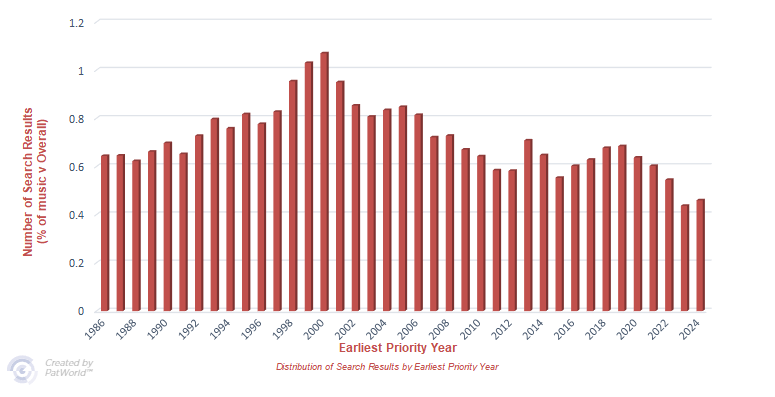
Filing Trends (Music v All %)
The team at PatWorld recently analysed global patent activity in the music technology space. The findings — covering trends over the past 40 years — revealed intriguing patterns. While overall filing volumes have increased significantly, music-related filings have maintained a steady, if relatively niche, share of global innovation, accounting for around 1% of all filings.
“That might sound small,” Iain says, “but when you consider the sheer number of sectors covered by patents — from pharmaceuticals to telecoms — it’s actually quite remarkable that music tech consistently holds its ground. It’s alive and kicking.”
Though fluctuations exist, the data indicates a resilient and relevant sector. “The technology behind music is evolving rapidly,” Iain adds. “A lot of innovation has continued around musical instruments and hardware, and there is increasing growth in areas like software (for example, DAW plugins), and now generative AI.”
Surprising Innovators — and Why They Matter
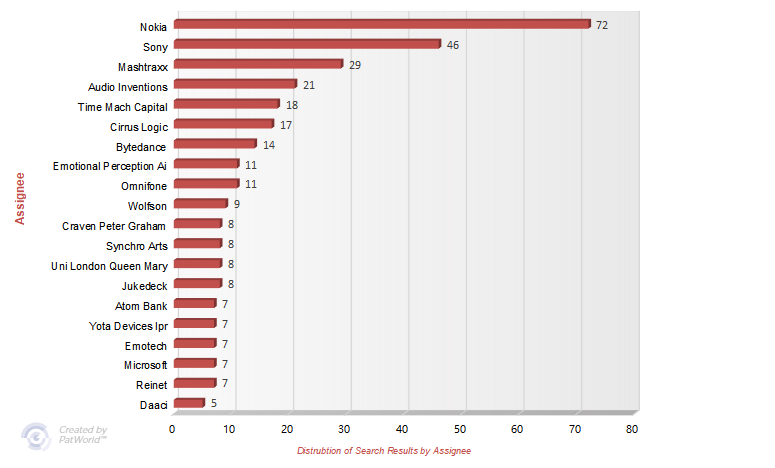
One of the more unexpected findings in the PatWorld data was the presence of non-traditional music companies among the top UK-based patent filers in music tech — names not typically associated with instruments or music.
Assignees
According to Iain, this may reflect how music overlaps with audio, voice recognition, UX design, and even AI platforms. “You start with questions like ‘what is music tech?’ and you realise it blurs into other sectors. Some of these filings may be classified under music, even if music isn’t the core focus.”
These cross-sector innovations highlight the value of due diligence. “For start-ups especially, resources are limited. But understanding who’s working in your space — even tangentially — can help shape a smarter IP strategy,” says Iain.
Prosecution Realities: Music vs. Finance
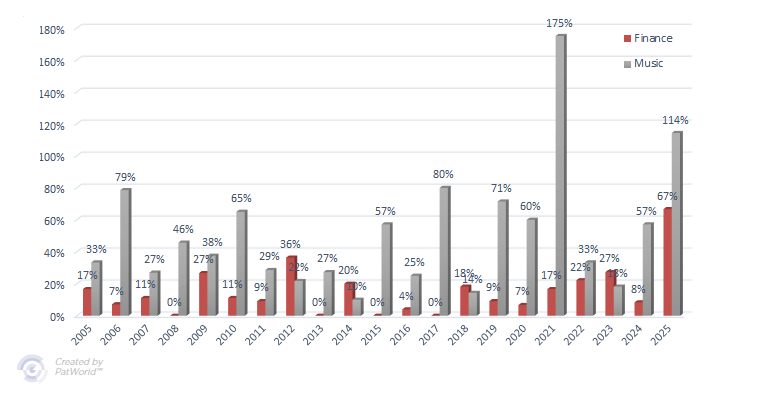
Another striking insight from the data was the comparison between software patent outcomes in music versus finance. In the UK, music-related software patents have consistently higher grant rates than financial software.
Prosecution Outcomes
Why? “Music tech often involves real-world signals — audio captured by microphones, processed, and output in new ways,” Iain explains. “That tends to be seen as more ‘technical’ under UK patent law. Financial software, which some patent offices consider to be about processing more abstract data, faces a steeper challenge.”
The takeaway? Music tech is a relatively fertile ground for software-based patents as well as patents with a hardware focus — a critical insight for inventors unsure about what is patentable.
The Global Soundstage
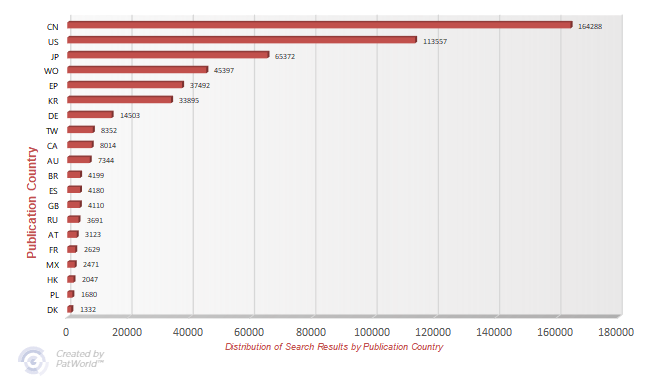
Patent filing activity in music tech is geographically diverse, with strong representation from China, the US, Japan, Europe, and South Korea. For UK-based companies, this raises important strategic questions.
Territories
“Even if you’re just operating locally, you need to think internationally,” Iain advises. “You might not plan to sell in the US or Japan, but someone else might — and licensing or selling your IP could be a revenue stream. The key is to consider your options early.”
Emerging Themes: AI, MIDI and More
Iain is particularly interested in the evolving world of AI-generated music, but his fascination stretches back to what might be seen as the humble MIDI file — a digital representation of the ‘DNA’ of certain types of music.
“Technology lets us record, edit and produce music in ways that were unimaginable when I first started recording music in my parents’ garage 25 years ago,” he says. “With a basic setup, I can now create a full track — vocals, guitar, drums, effects — from my home. It’s endlessly creative, and patents play a part in enabling that creativity.”
As AI continues to redefine what’s possible in music, the lines between creator, instrument, and software can grow increasingly blurred — a challenge for innovators, and an opportunity for those who understand the IP landscape.
Advice for Music-Tech Innovators
For early-stage music-tech companies, Iain offers a few guiding principles:
– Know your IP toolkit: patents, trade secrets, trademarks, registered designs, and especially copyright can all play important roles in music-related ventures.
– Do your research: novelty searches, competitive analysis, and understanding prior art can significantly increase your chances of success.
– Find the right support: working with advisors who understand both tech and music helps make your case clearer to examiners and collaborators.
Above all, Iain encourages innovators not to underestimate what’s patentable: “Even in something as well-established as guitars, there are thousands of patents — pickups, strings, fretboards, you name it.”
Celebrating Music and IP — Together
World IP Day is a reminder that behind every beat, riff, and chorus, there’s innovation at work. It’s in the algorithms, the amps, the apps, the streaming platforms, and the instruments themselves.
And thanks to professionals like Iain Russell, the inventors driving this innovation have someone to help them protect it.
About Russell IP
Iain Russell is a UK and European patent attorney and founder of Russell IP, a firm dedicated to supporting tech innovators. He’s also an inventor and lifelong musician.
DefibFest is a not-for-profit event raising money for life-saving defibrillators through the power of live music. Watch this space for more on their October 2025 event in London.
Postscript: Supporting the Beat Behind the Scenes
This article would not have been possible without the insights and expertise of Iain Russell, whose passion for music and deep understanding of intellectual property shaped every part of this story. Our thanks also go to Casey Higgon, IP Manager at PatWorld, for producing the data-led research and charts that supported the analysis.
At PatWorld, we work closely with patent attorneys and IP professionals to provide the tools and insights they need to support innovators — including those operating in the ever-evolving music technology space. Our intuitive patent search platform, combined with expert-led support and training, helps uncover competitive landscapes, track filing trends, and strengthen client strategies.
To find out how PatWorld can support your firm or in-house team, check out the links below or contact us directly on [email protected].
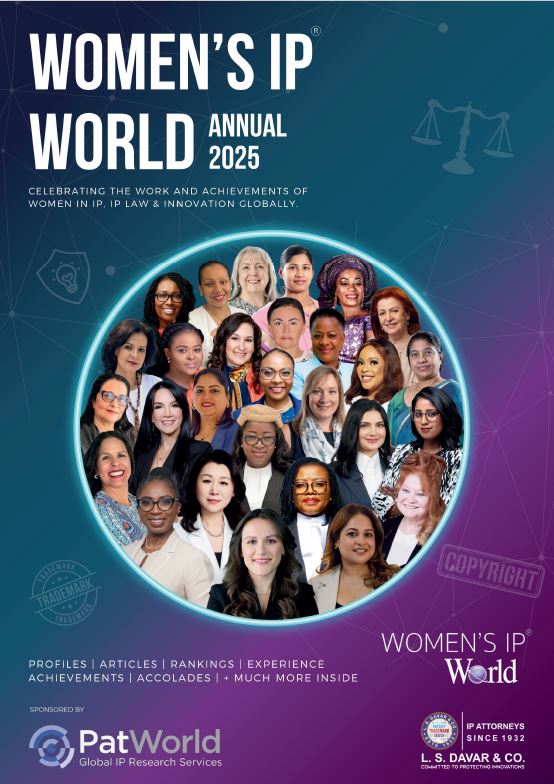
PatWorld is proud to feature in the 2025 edition of Women’s IP World, spotlighting our leadership in IP innovation and education. As co-sponsors of this year’s issue, we share the story behind our new “Introduction to Patent Searching” course — a user-friendly, AI-enhanced training tool designed for IP professionals at every stage of their careers.
This year’s highlights include:
A letter from Kathryn Parry, our Sales and Marketing Manager, reflecting on a year of innovation, teamwork, and the expansion of our AI-driven tools.
A deep dive by Digital Marketing Manager Sue Leslie into the creation of our e-learning course — blending practical skills with AI marketing insights.
These features highlight how PatWorld is helping to reshape IP education with accessible, engaging, and practical learning resources. By integrating advanced technology with real-world know-how, we’re empowering professionals to navigate today’s complex patent landscape with confidence.
These articles reflect PatWorld’s ongoing mission to simplify IP research, expand access to quality patent education, and celebrate the role of women in the industry.
Contact us at [email protected] for details of discounts for readers of the Women’s IP World and CIPA Members.
If you’re already well-versed in patent searching and looking for a powerful tool to enhance your research, explore our PatWorld Database for advanced search capabilities. Alternatively, if you’d prefer to leave the searching to the experts, our professional team is here to help. Check out our Search Services for expert-led patent searches tailored to your needs.
Why IP Insurance Matters: David Bloom’s Mission to Protect Innovation
In the complex and ever-evolving world of intellectual property (IP), safeguarding innovations is a challenge many businesses face. While patents, trademarks, and copyrights provide legal protection, enforcing these rights can be costly—especially for small and medium-sized enterprises (SMEs). This is where David Bloom, founder of Safeguard iP, comes in. As the UK’s only dedicated intellectual property insurance broker, David is on a mission to make IP protection accessible and affordable for businesses of all sizes.
In this ‘Meet the IP Professional’ feature, we explore David’s journey from IP litigator to insurance broker, the importance of IP insurance, and how Safeguard iP is helping businesses defend their most valuable assets.
From IP Litigation to IP Protection
David Bloom began his career as a solicitor specialising in IP law, working at the highly respected firm Olswang LLP, followed by Pinsent Masons. During his time as a litigator, he handled numerous patent disputes and trademark cases, working with both large corporations and small businesses.
“I saw first-hand how devastating IP litigation could be for SMEs,” David recalls. “Many businesses assumed that having a patent or trademark was enough to protect them. But in reality, these rights only give you the ability to take legal action if someone infringes them—and litigation is incredibly expensive.”
Time and again, David encountered clients who, despite having strong IP rights, were unable to afford the high costs of enforcement. For larger corporations, litigation costs could be absorbed within their legal budgets, but for smaller businesses, the financial burden was often insurmountable.
“The system felt unfair,” he explains. “I knew there had to be a better way for SMEs to defend their IP without risking bankruptcy.”
The Birth of Safeguard iP
Determined to create a solution, David transitioned from law to insurance, founding Safeguard iP, the UK’s only dedicated IP insurance brokerage. Unlike general insurance brokers, Safeguard iP exclusively focuses on intellectual property protection.
“There were existing IP insurance products in the market, but they were often too expensive or too limited in coverage,” David notes. “My goal was to help insurers develop policies that truly met the needs of SMEs—affordable, comprehensive, and easy to access.”
Safeguard iP works with businesses to assess their risks and find the right insurance solutions, ensuring they can enforce their IP rights and defend against infringement claims without financial strain.
Why IP Insurance Matters
Many businesses underestimate the risk of IP disputes. However, with over 500,000 new businesses incorporated in the UK each year, the number of potential IP conflicts is rising.
“There’s more IP being created than ever before,” David explains. “As a result, unintentional infringement is becoming more common. Whether it’s a start-up unknowingly infringing on an existing patent or a company facing a trademark challenge, the risks are significant.”
Without insurance, businesses facing IP litigation often face a tough choice: abandon their claim or risk financial ruin. IP insurance changes the equation by providing financial backing for legal action.
“When a company is insured, they can act decisively,” David says. “In many cases, just informing an opponent that you have IP insurance leads to a faster settlement—because they know you have the funds to fight.”
How Safeguard iP Supports Patent Attorneys
Safeguard iP has built strong relationships with patent and trademark attorneys, who frequently refer clients to David’s services.
“Many patent attorneys find that clients hesitate to file patents because they worry about the cost of enforcement,” he explains. “By introducing them to IP insurance, attorneys can reassure their clients that their rights can be protected affordably.”
While UK Financial Conduct Authority (FCA) regulations prevent patent attorneys from advising on specific insurance policies, they can educate clients about the existence and benefits of IP insurance, referring them to specialists like David.
“Most attorneys want their clients to feel confident in their IP strategy,” he adds. “By discussing insurance, they’re helping clients make informed decisions about protecting their assets.”
Making IP Insurance Accessible
In the past, getting IP insurance was a complicated and expensive process. Companies had to complete lengthy application forms, and quotes often came back far higher than the expected cost.
David has worked hard to streamline the process.
“Now, all I need is a company’s website address and revenue details,” he says. “I can provide a quote within 24 to 48 hours. For SMEs under £10 million turnover, policies are now significantly more affordable and predictable than they were a decade ago.”
Premiums for £1m of worldwide enforcement and defence cover are circa £3,500 and £2,500 for £500k of cover.
Thanks to these improvements, the number of businesses purchasing IP insurance has grown significantly in the last five years.
The Future of IP Insurance
As the demand for IP insurance increases, David predicts lower prices and broader coverage in the future.
“More policies mean more data for insurers, which helps them refine their risk models and reduce premiums,” he explains. “It’s a virtuous cycle—more businesses buying insurance leads to lower costs for everyone.”
Additionally, coverage is expanding. While policies traditionally covered only defence costs, new offerings now include:
Enforcement coverage (to fund legal action against infringers)
Title disputes (to resolve ownership conflicts)
Patent opposition and invalidity claims (to defend against challenges)
Looking ahead, David hopes insurers will develop policies that cover the loss of IP value—for instance, if a patent’s worth drops significantly due to legal issues.
Final Thoughts
David’s mission is clear: make IP insurance accessible, affordable, and effective. His legal expertise and deep understanding of the challenges SMEs face set Safeguard iP apart in the market.
For businesses with valuable IP assets, David’s advice is simple: “Don’t wait until there’s a problem to think about insurance.” The right coverage can mean the difference between defending your innovations and losing them to legal disputes.
With growing awareness and improved accessibility, IP insurance is no longer a niche product—it’s becoming a critical tool for businesses looking to protect their competitive edge.
Get in Touch with David Bloom
If you’d like to learn more about how Safeguard iP can help protect your business, visit safeguardip.com or connect with David Bloom on LinkedIn: David Bloom | LinkedIn.
How PatWorld Supports IP Protection
At PatWorld, we understand the importance of comprehensive IP protection. We work with companies to provide Freedom to Operate (FTO) searches, Invalidity searches, and a range of other IP-related searches. Our services help businesses mitigate risks, strengthen their IP strategies, and make informed decisions before entering new markets.
To learn more about how PatWorld can support your business, check out the links below.
Patent, Design, and Trademark Research Experts with a combined experience of over 200 years in Intellectual Property searching. Highly trained, dynamic in-house research teams specialising in a wide range of subject matter. All our analysts follow a training program developed by former IPO Examiners. Our teams are available to discuss any specific technical points regarding your search enquiries.





 Order a Search Now