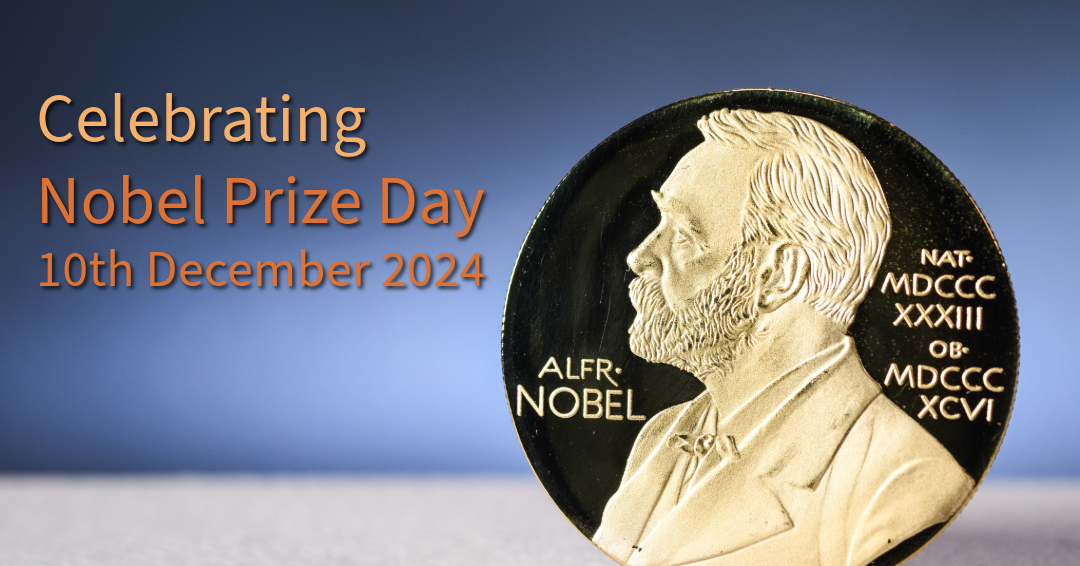
Today, we celebrate one of the most prestigious moments in the scientific, literary, and humanitarian calendar: Nobel Prize Day! On this day, the world comes together to honor the 2024 Nobel Prize winners, recognizing their ground-breaking contributions across Physics, Chemistry, Medicine, Literature, Peace, and Economic Sciences. Their work not only pushes the boundaries of human knowledge but also impacts society in profound and lasting ways.
Each year, the Nobel Prizes highlight individuals and organizations who have made extraordinary advancements in their fields. Whether it’s through a scientific breakthrough that transforms our understanding of the universe or a humanitarian effort that promotes peace and justice. Let’s take a closer look at the remarkable achievements of the 2024 Nobel Prize laureates and how their work is reshaping our world.
2024 Nobel Prize in Physics: Training artificial neural networks using physics.
The 2024 Nobel Prize in Physics was awarded to John J. Hopfield and Geoffrey E. Hinton for their foundational work in machine learning using artificial neural networks. Hopfield developed a network that stores and reconstructs patterns, while Hinton created the Boltzmann machine, advancing the ability to recognize elements in data. Their work, inspired by brain structures, has significantly contributed to artificial intelligence and its applications in various fields, including physics and material science.
2024 Nobel Prize in Chemistry: Cracking the code for proteins’ amazing structures.
The 2024 Nobel Prize in Chemistry was awarded to David Baker for computational protein design and to Demis Hassabis and John Jumper for their AI-based protein structure prediction. Baker created entirely new proteins using amino acids, which have applications in medicine and nanotechnology. Hassabis and Jumper developed AlphaFold2, an AI model that can predict the structures of millions of proteins, revolutionizing biological research. This work opens vast possibilities for advancing pharmaceuticals, antibiotics, and environmental solutions like plastic degradation. https://www.nobelprize.org/prizes/chemistry/2024/press-release/
2024 Nobel Prize in Medicine: The discovery of microRNA and its role in post-transcriptional gene regulation
The 2024 Nobel Prize in Physiology or Medicine was awarded to Victor Ambros and Gary Ruvkun for their discovery of microRNA and its role in gene regulation. Their work revealed how microRNAs, tiny RNA molecules, play a crucial role in regulating gene expression post-transcriptionally, controlling protein production in cells. This discovery has vast implications for understanding development, cell function, and diseases like cancer. Offering new insights into cellular mechanisms in multicellular organisms, including humans.
2024 Nobel Prize in Literature: Poetic prose that confronts historical traumas and exposes the fragility of human life.
The 2024 Nobel Prize in Literature was awarded to South Korean author Han Kang for her “intense poetic prose that confronts historical traumas and exposes the fragility of human life.” Han Kang, born in 1970 in Gwangju, South Korea, has explored themes of pain and resilience in works such as “The Vegetarian,” which won the Man Booker International Prize in 2016.
2024 Nobel Peace Prize: For efforts to achieve a world free of nuclear weapons.
The Nobel Peace Prize was awarded to Nihon Hidankyo, the Japan Confederation of A- and H-Bomb Sufferers Organizations. Established in 1956, Nihon Hidankyo has been instrumental in advocating for nuclear disarmament, representing survivors of the Hiroshima and Nagasaki bombings. The Nobel Committee recognized the organization’s efforts in highlighting the catastrophic humanitarian consequences of nuclear weapons and promoting peace.
2024 Nobel Prize in Economic Sciences: An explanation of why some countries are rich and others are poor.
The Nobel Prize in Economic Sciences was awarded to Daron Acemoglu, Simon Johnson, and James A. Robinson for their studies on how institutions are formed and affect prosperity. Their research has demonstrated the significant impact that inclusive political and economic institutions have on a nation’s economic development and the well-being of its citizens.
Looking Ahead: The Lasting Impact of the 2024 Nobel Laureates
The 2024 Nobel Prize winners have shown that human ingenuity knows no bounds. From advancing technology and medical science to fostering peace and human rights, their contributions are reshaping our world and paving the way for a brighter future. As we celebrate these extraordinary individuals and organizations on Nobel Prize Day, we are reminded of the importance of investing in research, creativity, and humanitarian efforts. These laureates have not only made remarkable strides in their respective fields but also inspire the next generation of innovators, scientists, writers, and activists.
Their work teaches us that change often begins with a single idea, and with persistence and dedication, those ideas can grow into achievements that benefit all of humanity.
Protecting the Future of Innovation: Why Intellectual Property Matters
As we celebrate the innovations of Nobel laureates, it’s also crucial to recognize the importance of protecting intellectual property. Securing patents helps ensure that ground-breaking discoveries are safeguarded, allowing inventors and researchers to maintain control over their innovations and encourage further development. Whether you’re working in science, technology, or creative fields, conducting thorough patent searches is essential to protecting your ideas.
By partnering with PatWorld, you can streamline the patent search process. Ensuring that your innovations are safeguarded from infringement and helping you secure the future of your work. As the 2024 Nobel Prize winners remind us, every great discovery deserves protection to unlock its full potential.
Happy Nobel Prize Day to all, and congratulations to the 2024 Nobel Prize laureates for their incredible achievements! Your work is changing the world and inspiring a better future for generations to come.
Let PatWorld be your trusted partner in IP research and innovation.
Nobel Prize: Past Winners Whose Inventions Changed the World
The Nobel Prize, established by the will of Alfred Nobel, is awarded annually to individuals and organizations who have made significant contributions to humanity in fields like Physics, Chemistry, Medicine, Literature, Peace, and Economic Sciences. Over the years, some Nobel Prize winners’ inventions have profoundly transformed our world, touching nearly every aspect of life. From physics breakthroughs that have reshaped modern technology to medical discoveries that have saved millions of lives, the impact of these laureates is undeniable.
Let’s look at some of the most influential Nobel Prize winners and how their inventions have changed the world.
Wilhelm Röntgen was the first recipient of the Nobel Prize in Physics in 1901 for his discovery of X-rays in 1895. His invention revolutionized the medical field, allowing physicians to see inside the human body without surgery. Before Röntgen’s discovery, diagnosing internal injuries or diseases required invasive procedures, but X-rays enabled non-invasive diagnostics that have since saved countless lives. Today, X-rays are used not only in medical imaging but also in industries like engineering, security, and astronomy.
Marie Curie, one of the most iconic figures in science, won the Nobel Prize in Physics in 1903 (shared with her husband Pierre Curie and Henri Becquerel) for her work on radioactivity, and later won the Nobel Prize in Chemistry in 1911 for discovering the elements polonium and radium. Her pioneering research laid the foundation for many developments in nuclear physics and cancer treatment. Radium, for instance, became a key component in early cancer therapies. Curie’s work also opened the door to the harnessing of nuclear energy, which would later reshape global politics and energy industries.
Few discoveries have had as immediate and life-saving an impact as Alexander Fleming’s discovery of penicillin. Awarded the Nobel Prize in Medicine in 1945, Fleming’s discovery of the first antibiotic ushered in a new era of medicine, transforming the treatment of bacterial infections that were once lethal. Penicillin became widely available during World War II, saving the lives of millions of soldiers and civilians alike. It paved the way for the development of many other antibiotics, marking the beginning of the antibiotic age, which has dramatically increased human life expectancy and quality of life.
Though Albert Einstein is best known for his theory of relativity, he received the Nobel Prize in 1921 for his explanation of the photoelectric effect. This work was critical in the development of quantum mechanics and had far-reaching applications, most notably in the creation of solar cells. Today, solar panels—based on the photoelectric effect—are central to renewable energy production, providing a clean, sustainable power source. Einstein’s work has thus contributed to technologies that combat climate change and promote environmental sustainability.
The discovery of the structure of DNA by Francis Crick, James Watson, and Maurice Wilkins, awarded the Nobel Prize in Medicine in 1962, marked a turning point in the life sciences. Understanding the double-helix structure of DNA unlocked new frontiers in biology, genetics, and medicine. It laid the foundation for the Human Genome Project, genetic engineering, gene therapy, and modern biotechnology. Today, advancements in DNA research have led to personalized medicine, genetic testing for inherited diseases, and breakthroughs in cancer treatment.
Niels Bohr’s contribution to understanding atomic structure earned him the Nobel Prize in Physics in 1922. His model of the atom, which introduced quantum theory to explain the behaviour of electrons, became the foundation for modern atomic physics and chemistry. Bohr’s work influenced the development of quantum mechanics, which now underpins technologies such as transistors, lasers, and even quantum computers. From semiconductors in smartphones to MRI machines in hospitals, Bohr’s ideas have had a ripple effect across numerous industries.
The transistor is perhaps one of the most influential inventions of the 20th century. Bardeen, Shockley, and Brattain were awarded the Nobel Prize in 1956 for their work on semiconductors and the development of the transistor. This small electronic device forms the foundation of all modern electronics, from computers and smartphones to radios and televisions. Without the transistor, the Information Age would not exist. Its invention revolutionized computing and communications, making it possible for technology to evolve at the exponential pace we see today.
Robert Edwards, awarded the Nobel Prize in Medicine in 2010, developed in vitro fertilization (IVF), a technology that has brought the gift of parenthood to millions of families worldwide. Since the birth of the first IVF baby in 1978, this technology has evolved and improved, leading to millions of successful births. IVF has revolutionized reproductive medicine, offering hope to those struggling with infertility and advancing our understanding of embryology.
The COVID-19 pandemic highlighted the immense importance of mRNA vaccine technology, pioneered by Katalin Karikó and Drew Weissman, who were awarded the Nobel Prize in Medicine in 2023. Their ground-breaking work on modifying messenger RNA to create effective vaccines led to the rapid development of COVID-19 vaccines, which have saved millions of lives worldwide. The impact of their discovery goes beyond the pandemic, as mRNA technology holds promise for developing vaccines against other infectious diseases and treatments for various medical conditions, including cancer.
Conclusion
The Nobel Prize has long recognised individuals whose discoveries and inventions have shaped the course of history. These laureates—through their ground-breaking work in science, medicine, and technology—have changed the world in profound ways. Their contributions not only advanced their fields but also provided solutions to some of humanity’s greatest challenges, improving quality of life, health, and understanding of the universe. As Nobel Prize week unfolds, it is a reminder of the lasting power of innovation and the endless potential for discovery to transform the future.
Protecting Innovation: Partnering with PatWorld for Patent Searches
As these Nobel laureates demonstrate, ground-breaking inventions and discoveries have the power to transform industries and improve lives. However, protecting intellectual property (IP) is crucial for ensuring that innovators can continue to drive progress. Securing patents not only provides legal protection but also fosters further research and development by safeguarding an inventor’s rights. Whether you are a researcher, entrepreneur, or inventor, conducting a comprehensive patent search is essential to prevent infringement and protect your innovations. Partnering with a trusted patent search service like PatWorld can streamline the process, ensuring thorough and accurate patent searches. With their expertise, you can confidently protect your innovations, paving the way for future success while maintaining control over your intellectual property.
Let PatWorld be your trusted partner in IP research and innovation.
Patent, Design, and Trademark Research Experts with a combined experience of over 200 years in Intellectual Property searching. Highly trained, dynamic in-house research teams specialising in a wide range of subject matter. All our analysts follow a training program developed by former IPO Examiners. Our teams are available to discuss any specific technical points regarding your search enquiries.



 Order a Search Now