Saiful Khan is an Owner at Potter Clarkson with more than 25 years of experience in intellectual property. Working across a diverse range of technologies and international markets, he combines technical expertise with a strong commitment to education, diversity and inclusion, and helping clients make informed strategic decisions.
Name:Saiful Khan Role: Owner, Patent Attorney Firm / Organisation:Potter Clarkson Location: United Kingdom Areas of expertise: Patent strategy, software and AI inventions, telecommunications, international patent prosecution, licensing, diversity and inclusion
Finding the right path into IP
Like many people in the profession, Saiful’s route into intellectual property was not entirely planned.
After completing a PhD, he explored a number of possible career options, including academic research and management consultancy. One opportunity even involved research into spray technologies that reminded him of the needleless injections featured in Star Trek, a programme he readily admits being a fan of.
Ultimately, IP appealed because it brought together technical, commercial and legal thinking. It also played to one of his strengths: translating complex concepts into something others can understand.
“I’ve always been at the interface where I can work with people who are really smart and bring things down to something that can be understood by a wider audience,” he explains.
What convinced him he had found the right profession was the people. Early in his career, he recognised a shared way of thinking and problem-solving among his peers, and that gave him confidence that he belonged in the profession.
Leading through service
Saiful has been an Owner at Potter Clarkson for nearing two decades and previously served on the firm’s Board during a period of significant growth and transformation.
Looking back, he describes leadership as both a privilege and a responsibility. Rather than focusing on personal achievement, he sees leadership as an opportunity to serve others and help create the conditions for collective success.
“It is all about service,” he says. “How do you best serve, given the talents that each person has?”
His approach combines attention to detail with an understanding of the bigger picture. Whether advising clients or helping shape business strategy, he believes successful decision-making requires a deep understanding of people, systems and long-term objectives.
The attraction of variety
One of the aspects Saiful enjoys most about his work is the sheer breadth of technologies he encounters.
His background in engineering and materials science provided a foundation that has allowed him to work across disciplines ranging from medical devices and nanotechnology to telecommunications, software and artificial intelligence.
For Saiful, the appeal lies in the opportunity to continually learn.
“I’ve enjoyed knowing a little bit about this and a little bit about that,” he says. “It’s about understanding.”
That curiosity remains central to his work today and is something he believes is essential for anyone considering a career in patents.
Technology, AI and the importance of critical thinking
Having worked extensively with software-related inventions throughout his career, Saiful has observed first-hand how approaches to patenting software and AI continue to evolve across different jurisdictions.
While examination practices differ between patent offices around the world, he believes many of the established principles used for software inventions will continue to shape the treatment of AI-related technologies.
Beyond the legal and technical questions, however, he is particularly interested in the wider societal impact of AI.
For Saiful, access to information has never been greater, but information alone is not enough.
“Knowledge is at our fingertips, but it is not a substitute for critical thinking,” he says.
He believes education remains as important as ever and is concerned that overreliance on technology could reduce opportunities for people to develop the experience and judgement that come from solving problems themselves.
Rather than replacing human capability, he hopes AI will enhance it.
“What I’d like is for AI to make us smarter and better, not replace our capabilities.”
Understanding what matters to clients
Saiful’s client base ranges from multinational corporations managing extensive patent portfolios to SMEs and individual inventors making critical early-stage decisions.
While the scale may differ, his approach remains consistent: understand what the client is trying to achieve and provide advice that reflects their circumstances.
One question he frequently asks smaller businesses is simple but revealing: “Why is this important to you?”
For larger organisations, conversations often focus on how a particular patent fits within broader commercial and technology strategies. For smaller clients, each decision can carry greater significance.
What he enjoys most is helping clients navigate those choices and becoming a trusted adviser rather than simply a service provider.
The value of an international perspective
International collaboration has been a defining feature of Saiful’s career. Through his work with organisations including CIPA, AIPPI and IP Inclusive, he has developed a global perspective on both the profession and the issues shaping it.
He believes international engagement is fundamental to modern IP practice.
Although patent systems are not fully harmonised, he sees significant commonality across jurisdictions and believes understanding different perspectives leads to better outcomes for clients and the profession alike.
Perhaps more importantly, he says international collaboration reinforces a shared sense of humanity.
“What I find in the IP profession is that there are very, very many like-minded people in the international domain.”
Creating opportunities through diversity and inclusion
Alongside his client work, Saiful is widely recognised for his commitment to diversity and inclusion.
His motivation is straightforward: talent exists everywhere, and the profession should do everything possible to ensure people have the opportunity to succeed.
“For me, it’s always been about talent,” he explains.
Having progressed from what he describes as a position of low privilege to one of significant professional privilege, he feels a responsibility to help others access similar opportunities.
He is particularly passionate about ensuring people are judged on their abilities and potential, rather than their background or personal characteristics.
“What I’d like is for everybody who’s outstanding to be given that opportunity to progress.”
Supporting the next generation
Education and mentoring are also important parts of Saiful’s professional life.
As a tutor and international workshop leader, he values the opportunity not only to share knowledge but also to learn from others.
Teaching reinforces his own understanding while exposing him to different perspectives and approaches.
For those considering a career in patents, he highlights curiosity, analytical thinking and strong communication skills as essential attributes. Technical expertise matters, but so does the ability to understand complex information and confidently defend your own position.
Ultimately, he believes professionals must take responsibility for developing their own judgement rather than relying on others, or technology, to provide the answers.
Outside the office
Away from work, walking has become one of Saiful’s favourite ways to unwind.
Whether enjoying local walks with friends or taking part in guided walking holidays with his wife, he values the combination of exercise, conversation and time outdoors.
Travel also plays a role in helping him recharge. Recent highlights have included walking in Switzerland and exploring the Canadian Rockies, while future plans include a guided walking holiday in Jordan.
Although he admits he does not play as often as he would like, tennis remains another long-standing passion. Given the choice of an alternative career, he jokes that becoming an international tennis player might have been an attractive option.
Looking ahead
When asked what he hopes to see from technology over the next decade, Saiful returns to a theme that runs throughout both his career and his outlook on life: connection.
Drawing on his experience working in telecommunications, he believes the best technologies bring people together rather than drive them apart.
His hope is that future innovations, particularly in AI, will help people become more informed, thoughtful and capable, while maintaining appropriate safeguards and accountability.
“I’d like to see technology make us better human beings.”
Meet the IP Professional is a PatWorld interview series exploring the people and perspectives shaping the intellectual property profession. Discover more interviews in the Meet the IP Professional hub, and find out more about PatWorld, a global IP search provider working with IP professionals worldwide to support informed patent, design and trade mark decisions, on our About Us page.
Phil Sanger is the founder of Grey Wolf IP, where he advises startups and SMEs on patents with the benefit of a technical background in mechanical engineering. He talks about building a flexible, client-focused practice, helping smaller businesses make commercially sensible IP decisions, and using plain language to demystify patents.
Name: Phil Sanger Role: Founder and patent attorney Firm / organisation: Grey Wolf IP Location: Royal Leamington Spa, England Areas of expertise: Patents, startups and SMEs, mechanical engineering, software, telecoms, commercial IP advice, client strategy, patent education
From engineering to IP
Phil did not start out with a plan to become a patent attorney. He worked as an engineer for nearly four years after university, spending a year in Detroit in the automotive industry before deciding to return to the UK.
When he began looking at other options, a friend who was training as a patent attorney suggested the career might suit him. Phil was intrigued by the exams, the technical challenge and the long-term opportunity. He left engineering and took a role as a trainee at Withers & Rogers.
Building his own practice
The move into private practice eventually led to something more independent. Phil says he had reached a point where he was thinking about whether he really wanted partnership at a large firm or a different way of working.
He was drawn to SMEs, where he felt he could do the best work. A client (also a founder) encouraged him to set up on his own, and the timing felt right. He describes the decision as a mix of professional confidence and the simple belief that you only get one chance at these things.
Why smaller clients matter
Phil’s work now focuses strongly on startups and SMEs. He says every patent matters more to these clients because budgets are tighter and the commercial stakes are higher.
That means the advice has to be closely tied to business strategy. He wants to understand what the business is trying to do and how a patent application fits into that plan. In larger companies, he says, patents can sometimes be treated more like a numbers game. For smaller businesses, they are often core to the value of the business itself.
Engineering as an advantage
His engineering background still shapes the way he speaks with clients. Phil believes people often become guarded when they think they are talking to a lawyer, but technical familiarity from his experience as an engineer helps them relax.
He can talk to inventors in their own language because he has worked as an engineer in both large and small businesses. That experience, he says, helps him get closer to the business and give better advice. He is comfortable stepping beyond his strict technical comfort zone, too, as long as he can understand what the inventor is telling him.
Clear advice, not legal noise
Phil is keen on making IP accessible. He says the key is to understand the law, apply it to the facts and then explain the outcome in simple language.
He does not think attorneys should hide behind options. His preference is to explain the choices and then give a view on what he would do in the client’s position. Clients, he says, value that steer. He also sees education as part of the job, especially for people new to IP who need help understanding what the process means in practice.
Long-term client relationships
A strong client relationship, for Phil, is one where people feel able to pick up the phone without hesitation. He likes it when clients come to him early with ideas, problems and questions, not just with narrow patent instructions.
He also values being the trusted first call, whether that happens by phone, WhatsApp or voice note. Word-of-mouth referrals matter to him as a sign that the relationship is working. In his view, that is one of the best measures of success.
Changing landscape
Phil sees AI as one of the biggest shifts affecting the patent landscape, especially for startups and scaleups. He says many clients are already using AI tools to help shape early patent drafts, which raises questions about confidentiality and quality.
What interests him most is not the final output, but the conversation the client had with the AI while refining the invention. That can reveal useful detail for a quality patent draft.
Business lessons
Running his own firm has taught Phil that professional success and personal fulfilment often come from unexpected places. He says he still loves the work, but owning and running a business is a discipline in itself.
He works with a business coach, and he is still learning about strategy, hiring, marketing and finance. That ongoing learning is part of what he enjoys. He sees business ownership as a long-term skill, not a fixed destination.
Life beyond patents
Outside work, Phil spends much of his time with his two sons. He also plays squash, watches films and goes to gigs. More recently, he has started a year-long fitness programme focused on strength training and staying healthy.
He mentioned music and film with obvious enthusiasm, especially Sinners, which he found memorable for the way it mixes music, history and genre. He is also a fan of films that play with time, which connects neatly to the way he thinks about complex legal ideas.
Explaining law through film
For his pop-culture comparison, Phil chose Tenet. He sees a parallel between the film’s simple core idea and the way priority works in patent law.
Priority, he says, sounds straightforward at first. But once you start working through the practical consequences, it becomes complicated and a little mind-bending, much like how time works in the film. It is a playful but fitting way of showing how he likes to make technical subjects more relatable.
Advice for newcomers
Phil’s advice to anyone considering a move from engineering or another technical background into IP is to get some work experience first. He says the profession is rewarding, interesting and full of different career paths, but it is not engineering.
There is a lot of learning, a lot of exams and a major shift towards words and communication. Even so, he thinks the profession suits people who enjoy challenge and variety. After around 20 years in the field, he still loves it.
Meet the IP Professional is a PatWorld interview series exploring the people and perspectives shaping the intellectual property profession. Discover more interviews in the Meet the IP Professional hub, and find out more about PatWorld — a global IP search provider working with IP professionals worldwide to support informed patent, design and trade mark decisions — on our About Us page.
Peri Jones is a Chartered UK and European Patent Attorney at Abel + Imray, where she works across physics, engineering, and technology patents. Alongside her IP career, she has built a strong interest in STEM outreach and science communication, helping make complex subjects feel more accessible and encouraging more young people, particularly girls, to consider careers in science.
Quick Profile
Name: Peri Jones Role: Chartered UK and European Patent Attorney Firm / Organisation:Abel + Imray Location: Cardiff, Wales Areas of expertise: Physics, engineering and technology patents, science communication, STEM outreach
Finding the right blend of science and communication
Peri’s route into intellectual property began with a long-standing interest in science. Growing up in North Wales, astronomy was always present at home thanks to her father’s passion for telescopes and astrophotography.
“My dad had, and still has, a big interest in astronomy and astrophotography,” she explains. “The house always had telescopes in spare corners.”
She went on to study physics at Cardiff University before completing a PhD in the astronomy instrumentation group. During that time, she also realised she enjoyed communication and writing just as much as the technical side of science.
At university, a talk from a trainee patent attorney changed her perception of what a STEM career could look like.
“I remember thinking this sounds like the perfect job,” she says. “I could combine technical expertise with communication, writing and working with inventors.”
What appealed most was the variety. Rather than focusing on one narrow technical field, she was drawn to the idea of working across a wide range of technologies and industries.
Now part of the Physics, Engineering and IT team at Abel + Imray, Peri works with clients across diverse sectors, from optics and lenses through to aircraft technologies.
Leaving academia behind
Although she enjoyed academic research, moving away from university life was not an easy decision.
“There was a little hesitation,” she admits. “Once you step away from academia, it can be difficult to go back.”
She enjoyed the research process and the collaborative environment of university life, but also recognised the uncertainty that often comes with academic funding.
“I didn’t want to spend my future constantly fighting for funding every couple of years and always worrying about what would happen next.”
The move into patent law gave her a chance to apply the skills developed during her PhD in a more commercially focused environment. Those transferable skills quickly became apparent.
“Writing a thesis helped with writing patent applications, reading research papers helped with reading prior art, and collaborating with different departments helped with dealing with inventors.”
She was also surprised by how quickly trainees become involved in client work.
“I naïvely thought I’d spend the first couple of years training in the background,” she says. “But from day one, you’re involved in real client work.”
The qualification process also brought its own challenges.
“I underestimated how difficult the exams would be,” she admits. “Failing an exam for the first time was a shock, but it definitely made me more resilient.”
Bringing science to wider audiences
Alongside her legal career, Peri has remained heavily involved in STEM outreach and science communication. That interest developed during university, where she became increasingly aware of the gender imbalance in physics.
“I started realising there was quite a big divide between males and females in physics when I was at university,” she says.
During her PhD, she began giving talks and media interviews, often in Welsh, to help make science feel more approachable and visible to wider audiences.
“I really get a kick out of trying to communicate difficult topics to the public,” she explains. “If you break things down properly, they don’t need to feel complicated.”
After completing her doctorate, she spent a year working with science communication company Science Made Simple, delivering talks and workshops in schools and at public events across Wales and beyond.
Peri was also the first Welsh-speaking science communicator employed by the organisation. This allowed them to deliver outreach activities through the medium of Welsh for the first time.
That experience left a lasting impression, particularly when visiting small rural schools across Wales.
“It was really rewarding going into these schools and showing children what they could potentially do,” she says. “A lot of the pupils came from similar backgrounds to mine.”
She believes representation and accessibility are both important when encouraging young people into STEM.
“We need to abolish STEM stereotypes and make science feel fun and accessible to everyone, particularly young girls.”
Communication at the heart of IP
Peri sees strong communication skills as central to both outreach work and intellectual property law.
Recently, she visited a Cardiff primary school where pupils were challenged to invent solutions to everyday problems.
“They came up with brilliant inventions,” she says. “Some were a bit far-fetched, but they were creative and they solved a problem, which was the brief.”
Experiences like these have reinforced the importance of explaining technical ideas clearly and confidently.
“When discussing complex topics, I always try to relate them to something day to day,” she explains. “I think about how I’d explain something to my family.”
That same approach carries through into her work with clients.
“I think being a patent attorney has made me a clearer science communicator,” she says. “You always have to think carefully about your audience.”
Balancing innovation with caution around AI
Like many within the profession, Peri sees artificial intelligence as one of the biggest developments currently shaping the IP landscape.
She believes AI has genuine potential to improve efficiency, particularly when reviewing or summarising prior art documents.
“I’m hoping AI can help make some parts of the process to be more efficient and cost effective,” she says.
However, she is cautious about relying too heavily on the technology.
“AI is a useful tool, but it needs to be used carefully because it isn’t always right.”
She believes the strategic and human elements of patent work remain difficult to replace.
“Writing a good patent application is about much more than describing an invention,” she explains. “You need to understand the client, their business goals and what they want from the patent.”
For Peri, relationships and trust remain central to the profession.
“Patent attorneys work closely with clients and build trust with them. I don’t think that human element can be replaced by AI.”
Life beyond IP
Outside work, Peri enjoys running, cycling and spending time in the mountains of North Wales.
One of her proudest achievements was completing an ultra-marathon along the Welsh coastal path from Penarth to Ogmore.
“It was tiring, but fantastic,” she says. “The weather behaved for once, which was a miracle.”
She is currently focused on returning to pre-baby fitness and hopes to complete the Swansea Half Ironman in the future after postponing the event during pregnancy.
Whenever possible, she still heads back to Snowdonia.
“If you get a clear day in the Welsh mountains, you can’t beat it,” she says. “I’m probably biased because it’s home, but they’re just fantastic.”
Looking ahead
Reflecting on her career so far, Peri believes resilience has been one of the most valuable lessons she has learned.
“Being a patent attorney has definitely made me more resilient,” she says. “It’s a challenging profession, but also a very rewarding one.”
She also hopes more young people will become aware of intellectual property careers earlier in life.
“I didn’t know anything about the IP profession until university,” she says. “That’s why outreach and visibility are so important.”
Contact Details
LinkedIn: Peri Jones LinkedIn Firm Website:Abel + Imray
Meet the IP Professional is a PatWorld interview series exploring the people and perspectives shaping the intellectual property profession. Discover more interviews in the Meet the IP Professional hub, and find out more about PatWorld — a global IP search provider working with IP professionals worldwide to support informed patent, design and trade mark decisions — on our About Us page.
Matt Dixon is Executive Chair at Beck Greener LLP and a former President of the Chartered Institute of Patent Attorneys (CIPA). With more than three decades in the IP profession, he combines technical expertise, business leadership, and strategic insight to help innovative companies develop and protect intellectual property.
Name:Matt Dixon Role: Executive Chair Firm:Beck Greener LLP Location: London, United Kingdom Areas of expertise: Patent strategy, IP leadership, business growth, engineering and physics-based technologies, innovation strategy
From physics student to patent attorney
Matt’s route into intellectual property began while studying physics at Imperial College London in the early 1990s. Originally from Yorkshire, he describes himself as “proudly comprehensively educated” and admits that, unlike many of his peers, he had little interest in pursuing a PhD after graduation.
“At the time, practically everybody on my course was looking at doing further academic study,” he says. “I thought, ‘I want a proper job.’”
A visit to the university careers service introduced him to a profession he had never previously encountered: patent law.
“I filled out one of those career questionnaires, and it suggested two jobs, actuary or patent attorney,” he explains. “I’d never heard of patent attorneys, but the description sounded interesting.”
After researching the profession and applying to firms across the UK, Matt joined what was then Frank B. Dehn, now Dehns. He qualified there and later received a Gill Prize for achieving the top mark in the UK patent examinations.
Shortly after qualifying, Matt moved to Munich to help build the firm’s new office.
“We spent about three and a half years there and had our children while we were in Germany,” he says. “It was a brilliant experience.”
Building teams and businesses
Matt’s career later moved into leadership and business development roles, including a period at IP21, where he helped establish a London office for what was then a start-up firm.
“That was a really formative experience for me,” he says. “It was one of the first times I’d worked alongside someone thinking purely from a business perspective rather than just from an IP perspective.”
He credits that period with helping him better understand how professional services businesses operate commercially.
Matt later joined HGF, where he spent around a decade leading the engineering team as the firm expanded significantly across the UK and Europe.
“When I started leading the engineering group, it was much smaller,” he says. “By the end, we had around 40 people across multiple offices, including Munich.”
Following a period away from full-time leadership, Matt joined Beck Greener initially in a consultancy capacity before becoming Executive Chair in 2024.
The role focuses less on direct client work and more on supporting the long-term commercial development of the business.
“My job is really about maximising the commercial effectiveness of the firm,” he explains. “I’m not ‘the boss’ in the traditional sense. I’m there to guide, support and help shape the direction of the business.”
Under his leadership, the firm has experienced strong growth, including the acquisition of another practice and significant organic expansion.
Helping businesses understand the value of IP
Throughout his career, Matt has worked with companies ranging from early-stage start-ups to established multinational organisations. He believes the approach to IP strategy changes significantly depending on the stage of the business.
“For start-ups, it’s often about getting maximum value from limited budgets,” he says. “You’re helping them build something investable before they may even have a product on the market.”
That uncertainty, he explains, creates a unique challenge.
“You’re trying to build a patent portfolio that could protect a future global business, but you’re doing it with start-up finances.”
By contrast, larger organisations often have clearer commercial objectives and established markets.
“With more established businesses, you usually know what the products are, who the competitors are, and where the revenue comes from,” he says. “The IP strategy becomes much more closely aligned to broader business strategy.”
Matt has also seen the role of patent attorneys evolve considerably during his career.
“Years ago, patent attorneys mostly spoke directly with technical teams,” he explains. “You’d spend hours discussing inventions with scientists and engineers.”
Today, however, IP professionals are increasingly expected to communicate at board level.
“You now need to explain intellectual property in commercial terms,” he says. “You have to answer questions about value, investment, and business impact, not just technology.”
Leadership, mentoring and learning to listen
When discussing leadership, Matt is candid about how his perspective has changed over time.
“When I was younger, I probably thought having the best strategy or the best spreadsheet was enough,” he says. “What I’ve learned is that how people feel matters.”
He believes successful leadership depends not only on sound commercial planning, but also on understanding how decisions affect colleagues and teams.
“You can have the best plan in the world, but if people feel uncomfortable or dismissed, they won’t buy into it,” he says.
That people-focused mindset also shapes how he mentors younger professionals entering the profession.
“The most important thing I try to teach trainees is to be comfortable saying, ‘I don’t know,’” he explains.
For Matt, honesty and intellectual curiosity are essential skills for any patent attorney.
“You’re not expected to know everything,” he says. “The job is to understand quickly, ask the right questions, and then find the answer.”
A changing global IP landscape
While many of the day-to-day challenges within IP remain consistent, Matt believes one of the biggest long-term shifts has been the rapid rise of China within the global innovation economy.
“The scale of Chinese engagement with intellectual property systems is enormous,” he says. “And the speed of change has been remarkable.”
He compares China’s development to Japan’s transformation from low-cost manufacturing economy to global innovation leader, but notes that China’s transition has happened much faster.
“The quality of innovation coming out of China has improved dramatically,” he says. “Once a country becomes one of the biggest users of the patent system, naturally it also becomes more invested in protecting intellectual property rights.”
Matt believes this shift is already influencing how IP systems operate internationally, particularly in areas such as trade marks and designs.
Outside the office
Away from work, Matt enjoys live music and performs in a rockabilly band called Ronnie Ripple and the Rip Chords, where he plays rhythm guitar.
“We don’t gig constantly, but I really enjoy it,” he says.
He is also refreshingly honest about how he switches off from work.
“I’m not one of those people getting up at 4am for a wheatgrass smoothie,” he jokes. “I watch Netflix, go to the pub, and go to concerts.”
One recent highlight was seeing the Pet Shop Boys live in Birmingham, where Matt says his “dad dancing” received unexpected praise from fellow concertgoers.
When it comes to walking, his favourite place remains close to his Yorkshire roots: Digley Reservoir near Holmfirth.
Looking ahead
Reflecting on his career, Matt believes one lesson stands out above all others.
“How people feel matters,” he says. “That’s probably the biggest thing I’ve learned.”
It is a philosophy that now underpins both his leadership style and his approach to working within the IP profession. For Matt, technical expertise and commercial strategy remain important, but building trust, understanding people, and communicating clearly are what ultimately make long-term success possible.
Meet the IP Professional is a PatWorld interview series exploring the people and perspectives shaping the intellectual property profession. Discover more interviews in the Meet the IP Professional hub, and find out more about PatWorld, a global IP search provider working with IP professionals worldwide to support informed patent, design and trade mark decisions, on our About Us page.
John-Paul Rooney is a partner at Withers & Rogers LLP, based in Sheffield. With a background that began with an engineering apprenticeship, he has built a career in patent law focused on client relationships, firm leadership, and the growth of one of the firm’s most successful regional offices.
Quick Profile
Name:John-Paul Rooney Role: Partner Firm / Organisation:Withers & Rogers LLP Location: Sheffield, UK Areas of expertise: European and UK patents, client relationship management, electronics, video coding, IP strategy, Unified Patent Court matters, AI in IP practice
From apprentice technician to patent attorney
John-Paul Rooney’s route into the IP profession was far from conventional. He began his career as an apprentice technician at ICI Pharmaceuticals, now part of AstraZeneca, with no expectation that patent law would eventually become his career.
“I had absolutely zero idea that I would get into the IP profession,” he says.
During his apprenticeship, he studied part-time while working, eventually progressing from college to university. His early experience in industry exposed him to the commercial importance of patents, particularly within the pharmaceutical sector.
“We could see that when one of the blockbuster drugs that we made went off patent, the profit margin went down massively,” he explains. “That gave me a signpost to the existence of the IP profession and how important it was.”
After deciding to pursue university full-time, John-Paul studied electronics before completing a PhD involving a large-scale research project. It was towards the end of that doctorate that patent law first became a serious option.
Following his PhD viva, his supervisor suggested he would make a strong patent attorney because he could understand complex technology while communicating clearly with both engineers and business leaders.
“That was a great piece of career advice from him,” says John-Paul.
Finding the right culture
John-Paul joined Withers & Rogers LLP after applying to firms across the UK. He believes the firm’s openness to different backgrounds played a major role in that decision.
Today, as a partner, his responsibilities extend beyond client work. He serves on internal committees covering finance, quality, and risk management, while also leading several major client teams, including large US and UK accounts. He additionally runs the firm’s China desk, helping to build relationships with Chinese clients and associates, with particular success in new energy and biotech/pharmaceuticals sectors.
For John-Paul, culture has remained central throughout his career.
“Finding your people and a culture that fits you is really important,” he says. “Every patent attorney firm has a different culture, and I’m lucky to have found a great fit with Withers & Rogers.”
Building the Sheffield office
One of the defining parts of John-Paul’s career has been helping grow the Sheffield office of Withers & Rogers LLP over the last 15 years.
When he moved to Yorkshire to start a family, the firm did not yet have a regional office there. After spending time with another firm, he returned when the opportunity arose to help establish the Sheffield presence from the ground up.
“It was an opportunity I couldn’t resist,” he says.
What began as a small office with only a handful of people has since grown into a substantial regional operation employing over 40 people.
John-Paul believes two things made that growth possible: culture and energy.
“We developed a culture that could breed success,” he explains. “Being open, sharing information, supporting one another — that was really important. Then having the energy and desire to go out and communicate that to the world.”
He also highlights the importance of support from the wider firm.
“The rest of the firm really wanted the office to succeed,” he says. “That support was hugely important.”
Although hybrid working has changed office life, he believes in-person collaboration still plays a vital role in building strong teams and maintaining culture.
Technical understanding and client relationships
John-Paul’s engineering background continues to shape the way he works with clients today.
He recalls visiting a Sheffield-based client and immediately recognising elements of their equipment from his apprenticeship days.
“I knew exactly what I was looking at,” he says. “Their confidence in me went through the roof.”
That ability to understand technology quickly and communicate naturally with technical teams has become a key strength throughout his career.
He places particular importance on long-term client relationships.
“We really like building those long-term trusted relationships with our clients,” he says. “I enjoy seeing clients able to pick up the phone to discuss something difficult and for us to find a solution together.”
The changing IP landscape
Like many in the profession, John-Paul sees artificial intelligence as one of the biggest current shifts affecting IP practice.
“We are beginning to deploy AI more widely,” he explains, “but only as an assistant, not to do the work.”
He believes careful and responsible use of AI will become increasingly important across the profession.
Alongside AI, he also points to the growing influence of the Unified Patent Court in Europe.
“We’re involved in four litigations in that court at the moment,” he says. “It has definitely changed how IP is used.”
Later this year, John-Paul will also be speaking at the CIPA Congress in Manchester on the sustainability challenges facing the patent profession and its future direction.
Outside the office
Away from work, John-Paul enjoys spending time with his partner and three children. Living in the Peak District gives him plenty of opportunity for walking, particularly around Kinder Scout and Bamford Edge.
He is also a keen gardener with a growing interest in climbing roses.
“I think when I retire, I’ll be pottering around the garden most days,” he says.
Golf is another long-standing hobby. He plays competitively at his local course, which he jokes is close enough to see from his window.
Looking ahead
Reflecting on his career so far, John-Paul returns to the importance of finding the right environment and the right people.
“You’ve got to find a place with a culture that fits you, and vice-versa” he says.
His own path into the profession may not have been traditional, but he believes the industry is becoming more open to different backgrounds and experiences. Through internships and outreach initiatives, he hopes more people will discover opportunities in IP that they may never previously have considered.
Meet the IP Professional is a PatWorld interview series exploring the people and perspectives shaping the intellectual property profession. Discover more interviews in the Meet the IP Professional hub, and find out more about PatWorld, a global IP search provider working with IP professionals worldwide to support informed patent, design and trade mark decisions, on our About Us page.
Ana Vesperinas is an associate and European Patent Attorney at Barker Brettell, specialising in chemistry and materials innovation. With a career spanning academia, industry, and private practice, she brings a broad scientific perspective to IP, combining technical expertise with a strong focus on client understanding and tailored advice.
Name:Ana Vesperinas Role: European Patent Attorney Organisation:Barker Brettell Location: Birmingham, UK Areas of expertise: Chemistry, functional formulations, materials, cosmetics, patent prosecution
A career shaped by exploration
Ana’s path into intellectual property was far from conventional. After completing a PhD and gaining experience across academia and industry, she only discovered IP later in her career. While working in industry, exposure to patent processes sparked her curiosity. Conversations with in house attorneys led her to explore the field further, ultimately prompting her to undertake a postgraduate course in intellectual property. That decision marked a turning point. Ana moved into an in house IP role before transitioning to private practice, where she felt she could broaden her experience and deepen her legal expertise. Today, she reflects positively on her varied journey, seeing it as a strength that shapes how she works.
A role grounded in chemistry and strategy
Now part of the chemistry team at Barker Brettell, Ana’s work focuses heavily on patent prosecution, alongside drafting and strategic advisory work. She particularly enjoys the challenge of prosecution developing arguments, understanding inventions in depth, and working towards broad and meaningful protection for her clients. Her technical expertise spans functional formulations, cosmetics, and increasingly, innovative materials. Recent work has included developments in construction materials and environmentally focused technologies, reflecting a wider industry shift towards sustainability and efficiency. Staying close to innovation is important to her. She actively keeps up with scientific developments to ensure she remains connected to the technologies behind the patents she works on.
Putting clients at the centre
A defining feature of Ana’s approach is her emphasis on understanding her clients’ needs. Her experience across different sectors allows her to relate to clients from a variety of backgrounds and tailor her advice accordingly. She believes strong relationships are built on clear communication from the outset setting expectations, explaining processes, and being transparent about challenges. Responsiveness is also key. Ana makes a conscious effort to respond quickly to client queries, recognising the urgency that often underpins IP decisions. Ultimately, she aims to make the patent process feel less daunting, ensuring clients feel informed, supported, and confident throughout.
Navigating international perspectives
A significant part of Ana’s career has involved working closely with US based clients. Many of her clients are located in the United States, requiring her to adapt strategies to fit European patent practice. This often involves managing expectations where approaches differ between jurisdictions. A strategy that succeeds in the US may not translate directly to Europe, requiring careful adjustment and clear communication. Through this experience, Ana has developed a strong understanding of both systems, enabling her to bridge the gap and deliver practical, effective advice.
Alongside her work with US clients, Ana’s UK‑based client base has grown steadily, ranging from individual inventors and universities to middle and large corporations. Ana takes a tailored approach, adapting her advice to each client’s level of intellectual property knowledge and experience. She places particular emphasis on transparency, ensuring clients have a clear understanding of anticipated next steps, expected timescales, and associated costs.
Keeping pace with innovation
Ana is particularly interested in the rise of functional materials and environmentally conscious innovation. Developments in areas such as construction materials, CO₂ reduction, and battery technologies are shaping her current work. She sees a clear trend towards sustainability, with many new inventions designed to reduce environmental impact while maintaining or improving performance. For Ana, staying informed about these changes is essential not just for technical understanding, but to provide relevant and forward thinking advice to clients.
Lessons in balance and perspective
Working in IP has also influenced how Ana approaches challenges. Early in her career, she felt pressure to address everything immediately. Over time, she has learned the importance of prioritisation and organisation. Managing a dynamic workload requires flexibility. Unexpected tasks can quickly reshape a carefully planned day, making adaptability a key skill. This shift in mindset has helped her approach her work more calmly and effectively, balancing urgency with structure.
Outside the office
Away from work, Ana enjoys staying active. Tennis and padel are regular pursuits, offering a way to unwind and reset after busy days. She also has a passion for skiing, often travelling to France or Switzerland with her family. When she cannot get to the mountains, she makes use of Birmingham’s indoor ski facilities. For Ana, these activities provide an important balance, helping her recharge and maintain focus in her professional life.
Encouraging different paths into IP
Reflecting on her own journey, Ana is keen to highlight that there is no single route into the profession. Entering IP later in a career can bring valuable experience and perspective. She encourages those considering a move into IP not to feel discouraged if they did not follow a traditional path. Experience gained in other roles particularly in science or industry can be a significant asset. Her own career stands as an example of how diverse experiences can lead to a fulfilling role in IP, combining technical knowledge with a strong understanding of client needs.
Meet the IP Professional is a PatWorld interview series exploring the people and perspectives shaping the intellectual property profession. Discover more interviews in the Meet the IP Professional hub, and find out more about PatWorld, a global IP search provider working with IP professionals worldwide to support informed patent, design and trade mark decisions, on our About Us page.
As the IP landscape becomes increasingly complex, the ability to interpret patent information and translate it into meaningful, commercial advice is more important than ever. At Mewburn Ellis, this is not the work of one individual, but a collaborative effort, bringing together different technical backgrounds, perspectives and approaches.
Following their contribution to an upcoming feature in The Global IP Magazine, published to coincide with INTA, we spoke to members of the Mewburn Ellis team to explore how they approach their work, what drives them, and how their individual expertise shapes the advice they provide to clients.
The team featured in this article includes:
William Hey– Patent Attorney and Senior Associate, Engineering Dan Thornton – Partner and Patent Attorney, Engineering Fran Salisbury – Partner and Patent Attorney, Life Sciences Paul Dunne – Partner and Patent Attorney, Chemistry
Together, they represent a cross-section of expertise across engineering and life sciences, working collaboratively to support clients navigating complex third party rights.
Different perspectives, one shared goal
Across engineering, chemistry and life sciences, the team at Mewburn Ellis works with patent data in different ways, but with a shared objective: to provide clarity in complex situations and support informed decision making.
Whether advising on freedom to operate, analysing technical and commercial landscapes or supporting strategic planning, the emphasis is always on interpretation. Understanding not just what the data shows, but what it means in practice.
That shared mindset is reflected in how each individual approaches their work.
William Hey – structuring complexity
Working extensively with patent landscapes and large datasets, William Hey focusses on bringing structure to complexity.
For him, the critical part is how the patent data found is organised and interpreted. By grouping and analysing information in a structured way, William helps turn large sets of search results into something meaningful, enabling both the team and their clients to identify patterns, trends and areas of focus more clearly.
He particularly enjoys the variety that comes with working in intellectual property.
“Working in private practice offers small windows into lots of different businesses,” he explains. “You often gain a real sense of a client’s company culture, along with an appreciation of their business strategy and the wider industry they operate in. With those insights, our team’s work is so much more useful to those clients..”
Outside of work, William enjoys practical, hands-on pursuits. Having completed a house renovation, he is now turning his attention to transforming an empty field into a new allotment. He also enjoys walking in the Peak District with his wife, occasionally flying his drone, and playing the piano.
For Dan, the most rewarding part of the role is working closely with clients and understanding how intellectual property fits into their broader commercial plans.
“I love working directly with clients,” he explains. “Sitting quietly and drafting a spec or a response is only part of the job. Learning about a client’s commercial plans and strategising together to ensure that their IP activities serve their goals is what I enjoy the most.”
Dan’s work focuses on helping clients navigate third party rights and creating and pursuing patent portfolios with real relevance in context. He approaches his work with an open mind. This has led him to bring an element of creativity to client work.
His approach is grounded in understanding the bigger picture, ensuring that analysis is aligned with the decision a client ultimately needs to make. Many of the most interesting client projects need the team approach; Dan enjoys working with his colleagues on planning and delivering these projects.
Outside work, Dan spends much of his time with his family. Living close to the hills, he enjoys getting outdoors with his three children and their new puppy, Peggy, often combining walks with a keen eye out for steam trains for his youngest.
Fran Salisbury – navigating life sciences complexity
For Fran Salisbury, working in life sciences brings a different dimension to patent analysis, one shaped by long development timelines and evolving technologies.
“In life sciences, you are often dealing with technologies that are still developing,” she explains. “You might be assessing risk before a product is fully defined.”
This requires a careful balance. Too much detail too early can be as unhelpful as too little, particularly when technologies may change over time.
Fran particularly enjoys the problem solving aspect of her role.
“I enjoy taking a jumble of information and ideas and bringing them together into a coherent strategy, or pulling the threads together to form an argument.”
She also values the international nature of IP work, working with attorneys, clients and patent offices globally.
Outside of work, Fran enjoys being outdoors, skiing, swimming and hiking, as well as quieter creative pursuits such as painting and drawing.
Paul’s work focusses on contentious matters, helping clients understand their options for clearing the way of competitors’ rights and defending their own patents.
A recurring theme in his work is distilling a large mix of documents into sharp and impactful arguments, cutting out unnecessary complexity. For smaller clients, Paul highlights that many assume that holding a patent gives them the right to use a technology, when in reality it provides the right to prevent others from doing so.
His approach is centred on clarity, ensuring that clients understand both the risks they face and the options available to them, so they can make informed, pragmatic decisions. He particularly enjoys working closely with clients in a collaborative way, feeling embedded within in house teams rather than operating as a separate external adviser.
“The joy of private practice is getting to work with lots of interesting, enthusiastic clients on a variety of tech,” he says. “The thing I enjoy most is feeling properly embedded with an in-house team, when the work feels like a collaboration instead of a transaction.”
Outside of work, Paul enjoys spending time with his wife, two children and spaniel Archie. Whether walking through the woods or visiting the beaches of Somerset, he values time outdoors with his family. He also enjoys carving out time to play the piano and go swimming.
While each team member brings a different perspective, it is the combination of these approaches that enables Mewburn Ellis to deliver well-rounded, commercially relevant advice.
Strategic thinking, structured analysis, technical depth and clear communication all play a role, supported by collaboration both within the team and with external partners.
Meeting the team at INTA
Fran, along with many of the Mewburn Ellis team, will be in London during INTA. If you are attending and would like to meet, they would be very happy to connect and continue the conversation in person.
Mewburn Ellis works closely with specialist search providers such as PatWorld to ensure that searches are aligned with how the results will be used in practice. By tailoring search outputs to the firm’s analytical approach, PatWorld provides datasets that support structured analysis and enable the team to focus on interpretation, insight and client advice.
Meet the IP Professional is a PatWorld interview series exploring the people and perspectives shaping the intellectual property profession. Discover more interviews in the Meet the IP Professional hub, and find out more about PatWorld, a global IP search provider working with IP professionals worldwide to support informed patent, design and trade mark decisions, on our About Us page
Pamela Bryer is a Partner and Patent Attorney at Marks & Clerk, based in Edinburgh. With a background in physics and photonics, she specialises in supporting innovation across emerging technologies, with a particular focus on design protection and the strategic use of intellectual property in fast-moving sectors.
Name:Pamela Bryer Role: Partner and Patent Attorney Firm:Marks & Clerk Location: Edinburgh, UK Areas of expertise: Patent and design protection, emerging technologies, IP strategy
From research to intellectual property
Pamela’s path into intellectual property began during her studies in physics and photonics at the University of St Andrews. Initially considering a career in research, she joined Marconi to work on tunable lasers for telecommunications systems.
However, she quickly realised that specialising in a single technology was not the right fit. Instead, she was drawn to the broader perspective offered by intellectual property.
“I didn’t necessarily want to know everything about one specific device. I’d much rather understand a wider range of technologies and how they work.”
Her exposure to patent strategy during this time, particularly designing around existing patents, sparked a lasting interest in the field.
A collaborative approach to innovation
At Marks & Clerk, Pamela values the firm’s collaborative and forward-thinking culture. She highlights the importance of working across disciplines and supporting both clients and colleagues.
“There’s always someone willing to listen, share ideas and help you think through problems in a different way,” she explains.
This collaborative environment allows her to work closely with clients, not only understanding the legal aspects of their innovations but also the commercial and technological context behind them.
Curiosity driving expertise
Pamela’s work spans a wide range of technologies, including AI, medtech and connectivity. Her interest in these areas is driven by curiosity and their real-world impact.
“What excites me most are technologies sitting at the intersection of innovation and impact,” she says.
From a patent perspective, these technologies present both opportunities and challenges. They often evolve rapidly and cross traditional boundaries, requiring flexible and forward-thinking protection strategies.
The strategic value of design protection
A key area of Pamela’s expertise is design protection, which she sees as central to product success.
“Design sits at the intersection of technology, usability, branding and customer experience,” she explains.
She believes that design rights can provide a valuable additional layer of protection, particularly in fast-moving sectors where user experience and product differentiation are critical.
Clients, however, often face challenges in deciding how and when to protect their innovations. With rapid development cycles and evolving technologies, early decisions must be made with limited information.
Pamela advises a proactive, portfolio-based approach, aligning patent and design strategies with product development to maximise long-term value.
Supporting innovation through diversity and collaboration
Pamela is a strong advocate for diversity and inclusion within the IP profession. She believes that a broader range of perspectives leads to better outcomes for both clients and innovation.
“Innovation itself is inherently diverse,” she notes, emphasising that different viewpoints help ensure that technologies are understood in their full context.
Her approach to mentorship reflects this belief. Having benefited from supportive mentors throughout her career, she now focuses on helping others build confidence and navigate what can be a complex profession.
“I try to be approachable and encouraging… supporting the next generation is one of the most rewarding parts of my role.”
Turning ideas into valuable IP
Working closely with clients is central to Pamela’s approach. She begins by understanding their objectives and the problems their technology solves.
“It’s about translating complex ideas into an appropriate combination of IP protection that is robust but also commercially meaningful,” she explains.
By distilling inventions down to their core concepts and aligning protection strategies with business goals, she helps clients create IP that supports growth, investment and long-term innovation.
Looking ahead: evolving technologies and IP practice
Pamela is particularly interested in developments in design law, including current reform in the EU and proposed reform in the UK. Some of these changes aim to better accommodate digital and dynamic designs, reflecting the evolving nature of modern products.
She also sees the integration of artificial intelligence within IP practice as both a challenge and an opportunity.
“We need to think about how to responsibly incorporate AI into our daily practice to produce better outcomes for clients,” she says.
Outside the office
Outside of work, Pamela enjoys activities that provide a different kind of mental challenge or allow her to switch off completely. Travel and photography are key interests, alongside quizzes, board games and time spent with family.
She also enjoys exploring new places and restaurants, and walking remains a favourite way to unwind. Close to home, Arthur’s Seat in Edinburgh is a regular destination, offering views across the city and coastline.
Further afield, she has completed a 500-mile section of the Appalachian Trail — an experience she describes as unforgettable.
One of her favourite travel destinations is Hoi An in Vietnam, a UNESCO World Heritage Site known for its historic architecture and vibrant food scene. It’s a place she particularly enjoys for its atmosphere, culture and distinctive character.
A balanced perspective on innovation
Reflecting on her career, Pamela emphasises the importance of curiosity, collaboration and adaptability. As technologies continue to evolve, she believes the role of IP professionals will become even more strategic. By combining technical understanding with commercial insight, they can help shape how innovation is protected and brought to market.
Her advice is simple: stay curious, remain open to new ideas, and never underestimate the value of collaboration in solving complex problems.
Pamela and members of the Marks & Clerk team will be in London for the International Trademark Association (INTA) Annual Meeting this May. If you’re also planning to be there and would like to connect, feel free to get in touch to arrange a meeting.
Meet the IP Professional is a PatWorld interview series exploring the people and perspectives shaping the intellectual property profession. Discover more interviews in the Meet the IP Professional hub, and find out more about PatWorld — a global IP search provider working with IP professionals worldwide to support informed patent, design and trade mark decisions — on our About Us page.
Gerard Byrne is a part-qualified patent attorney at Knights, with a background spanning patent examination, searching, and in-house analysis. His experience across the IP lifecycle gives him a distinctive perspective, particularly on how patent information can be used more strategically to support innovation and commercial decision-making.
Name:Gerard Byrne Role: Part-Qualified Patent Attorney Organisation:Knights Location: UK Areas of expertise: Patent drafting and prosecution, patent analysis, IP strategy, freedom-to-operate
A career shaped by perspective
Gerard’s route into IP began at the UK Intellectual Property Office, where he joined as a patent examiner after completing a degree in Mechanical Engineering. It wasn’t a carefully mapped decision, but it was the most interesting opportunity at the time, and one that quickly proved to be a strong fit.
From there, his career evolved steadily. After moving into private practice patent searching, he went on to work as an in-house analyst supporting engineering-led businesses, before securing a trainee patent attorney role. While the early steps were not always intentional, the direction became clearer over time.
“I always kind of wanted to be an attorney after entering the profession,” he reflects, noting that breaking into the profession can be challenging. His varied experience, however, has provided a strong foundation.
Seeing IP through different lenses
Few patent attorneys begin their careers across such a wide range of roles. For Gerard, each stage has shaped how he approaches his work today.
As a searcher, he developed a broad technical awareness, reviewing large volumes of patent literature across multiple fields. This gave him a practical understanding of how patent landscapes evolve and what makes a strong application.
His time as an in-house analyst shifted that perspective further. Patents became more than legal tools; they became part of the innovation process itself. “You start to see patents not just as legal instruments but as tools for driving and mapping innovation,” he explains.
Now, as a part-qualified attorney, those perspectives come together. His role involves balancing technical detail, strategic thinking, and commercial realities to deliver outcomes that align with client objectives.
From analysis to application
Gerard’s current role spans drafting applications, prosecuting cases before the UK and European patent offices, and advising on freedom-to-operate questions. The variety is a key part of its appeal.
“No two days look the same,” he says, describing work that ranges from drafting claims for mechanical inventions to advising clients on competitor activity.
His background in analysis continues to influence how he approaches drafting. In particular, it has made him more aware of the risks posed by prior art. Rather than treating drafting as a purely technical exercise, he sees it as a purposeful process, shaped by what may emerge during examination.
Patents as strategic tools
A consistent theme in Gerard’s experience is the idea that patents are often underused as strategic assets.
He points to the practical barriers that prevent wider engagement. Patent databases can be difficult to navigate, and the documents themselves are dense and technical. For many engineers, extracting meaningful insight from patent literature is not straightforward.
Yet the value is clear. Patent information can guide product development, highlight competitive activity, and inform commercial decisions at every stage of a project. Without that foundation, decisions risk being made without a full understanding of the landscape.
For Gerard, the future lies in better integration, embedding analytical thinking throughout the innovation process, rather than treating it as a standalone step.
Bridging roles and improving collaboration
Having worked both in-house and in private practice, Gerard has seen how differently IP can be approached. In-house roles bring a closer connection to commercial outcomes, while private practice offers broader exposure to technologies and industries.
“The ideal, honestly, is to have experienced both,” he notes, highlighting how each perspective helps to correct the blind spots of the other.
Collaboration plays a central role in making that work effectively. Whether working with inventors, litigators, or commercial teams, success often comes down to clear communication and mutual understanding. Translating between technical, legal, and business language is a key skill.
Developing as a patent attorney
Working towards qualification brings its own challenges. The exams are demanding, and success often depends on understanding exactly what is being asked.
For Gerard, managing that process comes down to consistency. “It’s just doing a little bit every day quite regularly,” he explains.
He also highlights the importance of a supportive training environment, with access to a varied caseload and structured guidance. Without that, candidates can find themselves struggling on multiple fronts.
His advice to others is practical: make full use of past papers and available resources and focus on understanding how to answer the question being asked.
Outside the office
Away from work, Gerard prefers to stay active. Skiing, scuba diving and hiking all feature, although the time of year often dictates which takes priority.
More recently, cooking has become a favourite way to unwind, particularly during the winter months when outdoor activities are less accessible. He enjoys experimenting with different cuisines, with a current focus on French cooking. It offers a creative contrast to the structure of his day-to-day work.
He also picked up the saxophone during the COVID pandemic, initially as a challenge and a long-term project. Largely self-taught, it remains a personal pursuit rather than a public one, but one that offers a different kind of focus outside the demands of IP work.
Looking ahead
As Gerard continues towards full qualification, his focus is on building a well-rounded practice that draws on all aspects of his experience. His journey highlights the value of seeing IP from multiple angles, and the benefits that brings to both clients and the profession.
With a growing emphasis on strategy, collaboration, and integration, he sees the role of the patent attorney continuing to evolve into something broader: not just a legal advisor, but a partner in innovation.
Meet the IP Professional is a PatWorld interview series exploring the people and perspectives shaping the intellectual property profession. Discover more interviews in the Meet the IP Professional hub, and find out more about PatWorld — a global IP search provider working with IP professionals worldwide to support informed patent, design and trade mark decisions — on our About Us page.
Peter McBride is the founder of Scintilla, a UK-based patent and trade mark firm. With a background in physics and private practice, he has built a business focused on client relationships, commercial clarity, and innovation, offering a modern approach to intellectual property strategy and advisory work.
Name:Peter McBride Role: Founder Firm:Scintilla Location: United Kingdom (Glasgow, Aberdeen, Manchester) Areas of expertise: Patents, trade marks, IP strategy, deep tech, client advisory
From physics to patent law
Peter’s route into intellectual property began during his time studying physics. Like many in the profession, he had not initially been aware of the career path.
After discovering the blend of technical and legal work involved, he applied directly to firms and secured a trainee role straight out of university.
His early career saw him develop within private practice, learning the technical and client-facing aspects of the role. Along the way, he credits several influential figures and colleagues who helped shape his development.
However, the idea of running his own business had been present much earlier.
Taking the leap to found Scintilla
Peter’s entrepreneurial mindset dates back to his school years, when he set up a small gardening business with a friend. While not a long-term venture, it sparked an interest in building something of his own.
Over time, that interest grew. As his career progressed, he began to feel that traditional firm structures did not align with how he wanted to work.
“I slowly just started getting frustrated… I’ve got ideas of how I want to do things,” he explains.
After careful consideration, he took the step to establish Scintilla in 2013. Starting alone, he handled every aspect of the business, from client work to finance and business development.
Those early days were challenging but rewarding. Building relationships and meeting potential clients played a key role in establishing the firm.
Evolving from practitioner to business leader
As Scintilla has grown, Peter’s role has shifted significantly. What began as a hands-on technical role has evolved into leading and developing a business.
He describes the transition as a common challenge for founders: moving from doing the work to building the organisation.
“It’s the cliché of working on the business instead of in it,” he says.
Today, his focus is more on team development, client relationships, and strategic direction. He still enjoys client work but increasingly values the opportunity to build a strong team and create opportunities for others.
This people-focused approach is a key motivator, alongside the satisfaction of growing the business itself.
Rethinking client relationships and pricing
A defining feature of Scintilla’s approach is its move away from the traditional billable hour.
Peter has long questioned whether time-based billing reflects the true value delivered to clients. Instead, the firm has introduced a model based on agreed pricing and defined outcomes.
“We have to focus on the outcomes that we deliver for clients,” he explains.
By agreeing fees in advance, clients gain predictability and avoid unexpected costs. This approach also shifts the focus away from time tracking and towards delivering meaningful results.
Peter believes this change improves trust and reduces one of the most common sources of tension in client relationships: fees.
Translating innovation into practical IP strategy
Working with innovators requires more than technical knowledge. For Peter, the key lies in understanding each client’s needs and communication style.
Some clients want detailed explanations, while others prefer concise guidance. Adapting to these differences is essential.
He also emphasises the importance of practical advice. Rather than presenting abstract legal analysis, he focuses on helping clients make informed decisions.
“What they want is guidance and a direction for you to steer them in,” he says.
This includes balancing legal considerations with commercial realities, particularly in fast-moving and complex sectors.
Industry trends and the rise of deep tech
Peter is seeing strong growth in areas such as artificial intelligence and quantum technologies.
“AI is in everything,” he notes, reflecting its widespread integration across industries.
In addition, Scintilla works extensively in what he describes as “deep tech”, covering areas such as semiconductors, photonics, and sensing technologies.
These sectors present both opportunities and challenges, particularly in terms of how innovation is protected and commercialised.
Building a culture around values and trust
As the firm has expanded across multiple offices, maintaining a strong culture has been a priority.
Peter has defined a set of core values, including being down to earth, authentic, visionary, compassionate, and resolute.
These values underpin a collaborative and supportive environment, where team members are encouraged to speak openly and learn from mistakes.
There is also a strong emphasis on long-term thinking. This applies not only to team development but also to client relationships, where flexibility and trust are key.
“We’re looking at the bigger picture all the time instead of just the short term,” he explains.
Outside the office
Away from work, Peter enjoys spending time with his family and staying active.
His hobbies include road cycling, mountain biking, running, and playing guitar. Recently, he has also added gardening to the list after moving house.
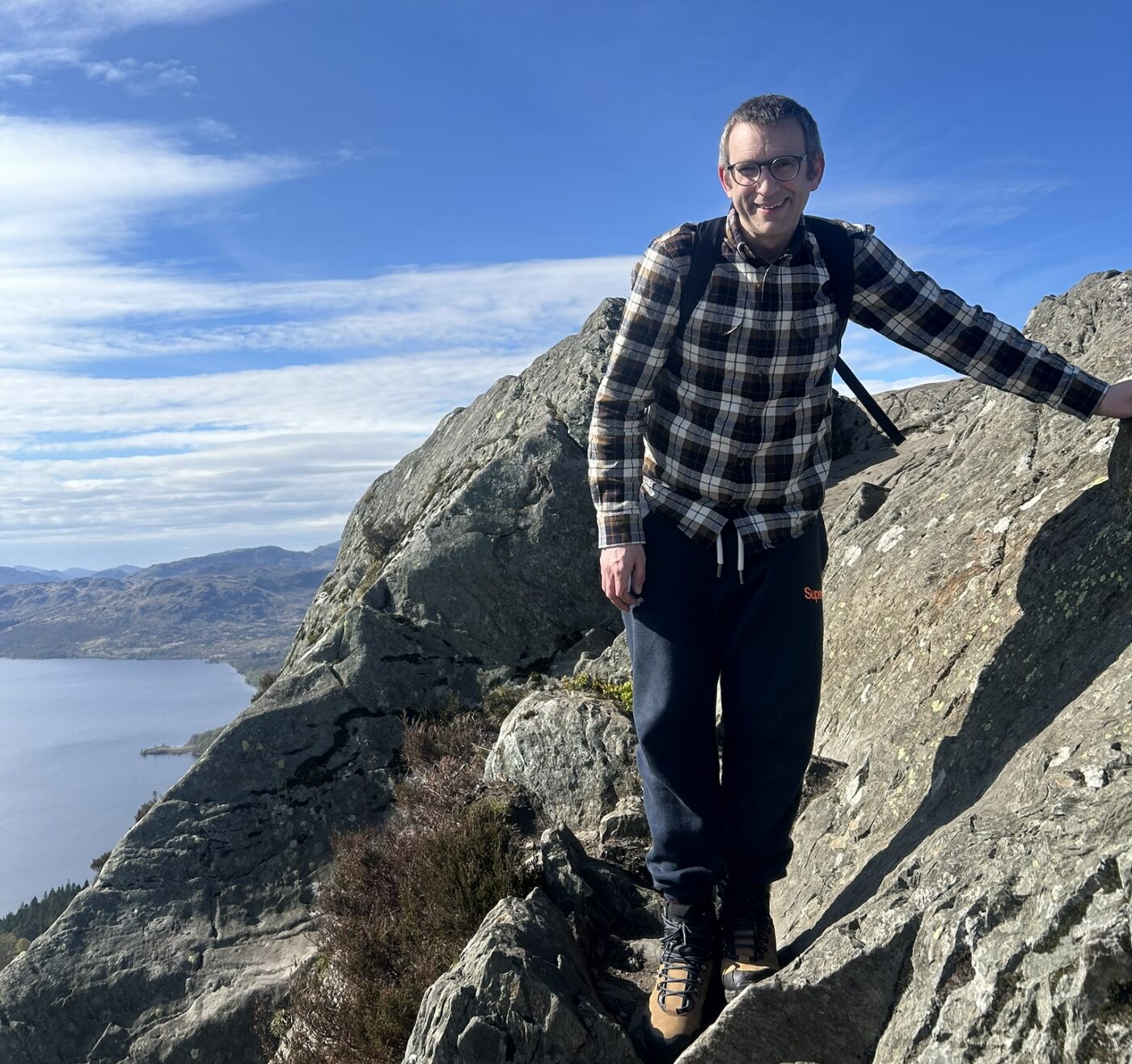
One of his favourite walks is Ben A’an, near Glasgow. It offers a rewarding climb with panoramic views, making it a popular choice for a quick escape from the city.
When it comes to downtime indoors, he admits he is not particularly drawn to board games. However, he does enjoy playing Catan with his family—especially when it avoids becoming too competitive.
Looking ahead
For Peter, the future of IP lies in combining technical expertise with commercial insight and strong client relationships.
As technology continues to evolve, the role of the adviser becomes even more important. Clients need clear guidance, practical thinking, and a trusted partner who can help them navigate complexity.
That philosophy continues to shape both his approach and the ongoing development of Scintilla.
Peter and members of the Scintilla team will be attending the International Trademark Association (INTA) Annual Meeting in London this May. If you’re also planning to be there and would like to connect, feel free to get in touch to arrange a meeting.
Meet the IP Professional is a PatWorld interview series exploring the people and perspectives shaping the intellectual property profession. Discover more interviews in the Meet the IP Professional hub, and find out more about PatWorld — a global IP search provider working with IP professionals worldwide to support informed patent, design and trade mark decisions — on our About Us page.
PatWorld Global IP Research Services
Patent, Design, and Trademark Research Experts with a combined experience of over 200 years in Intellectual Property searching. Highly trained, dynamic in-house research teams specialising in a wide range of subject matter. All our analysts follow a training program developed by former IPO Examiners. Our teams are available to discuss any specific technical points regarding your search enquiries.








 Order a Search Now